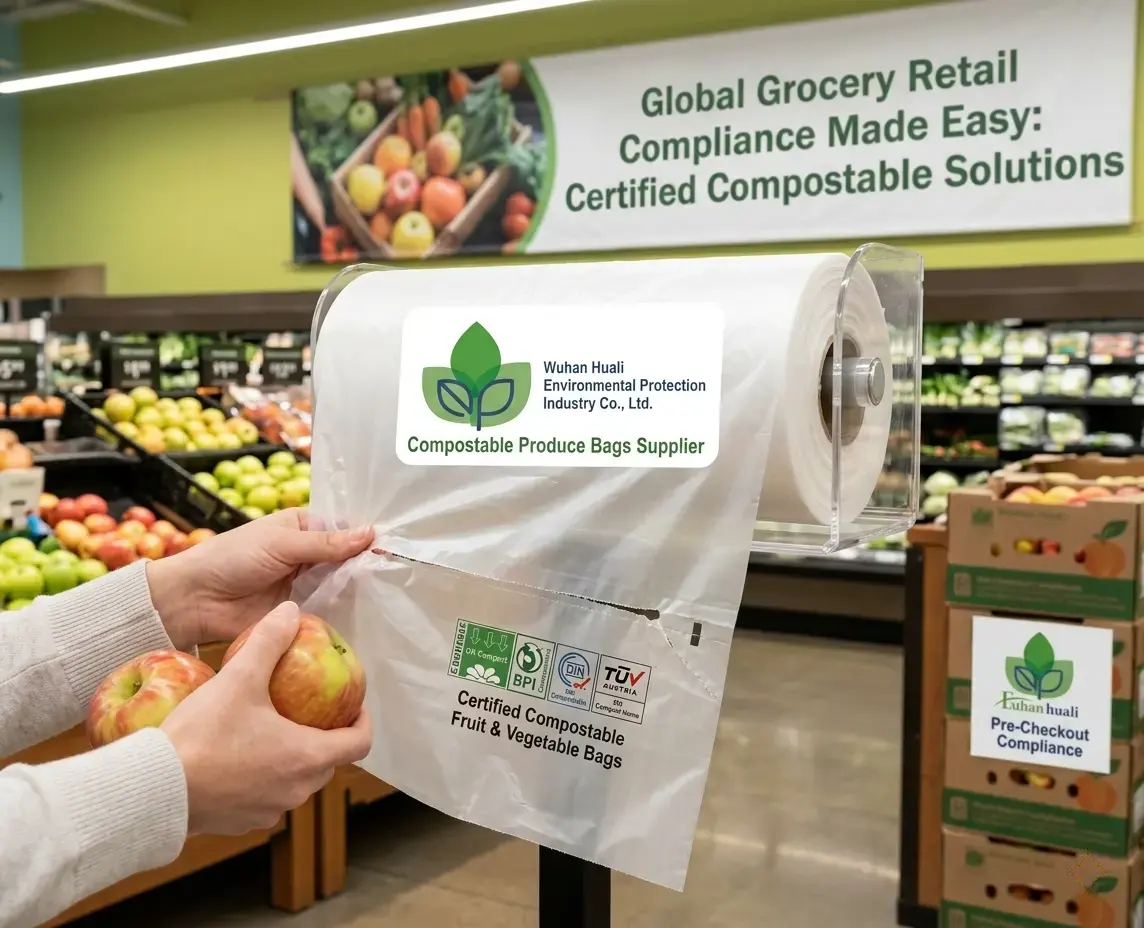
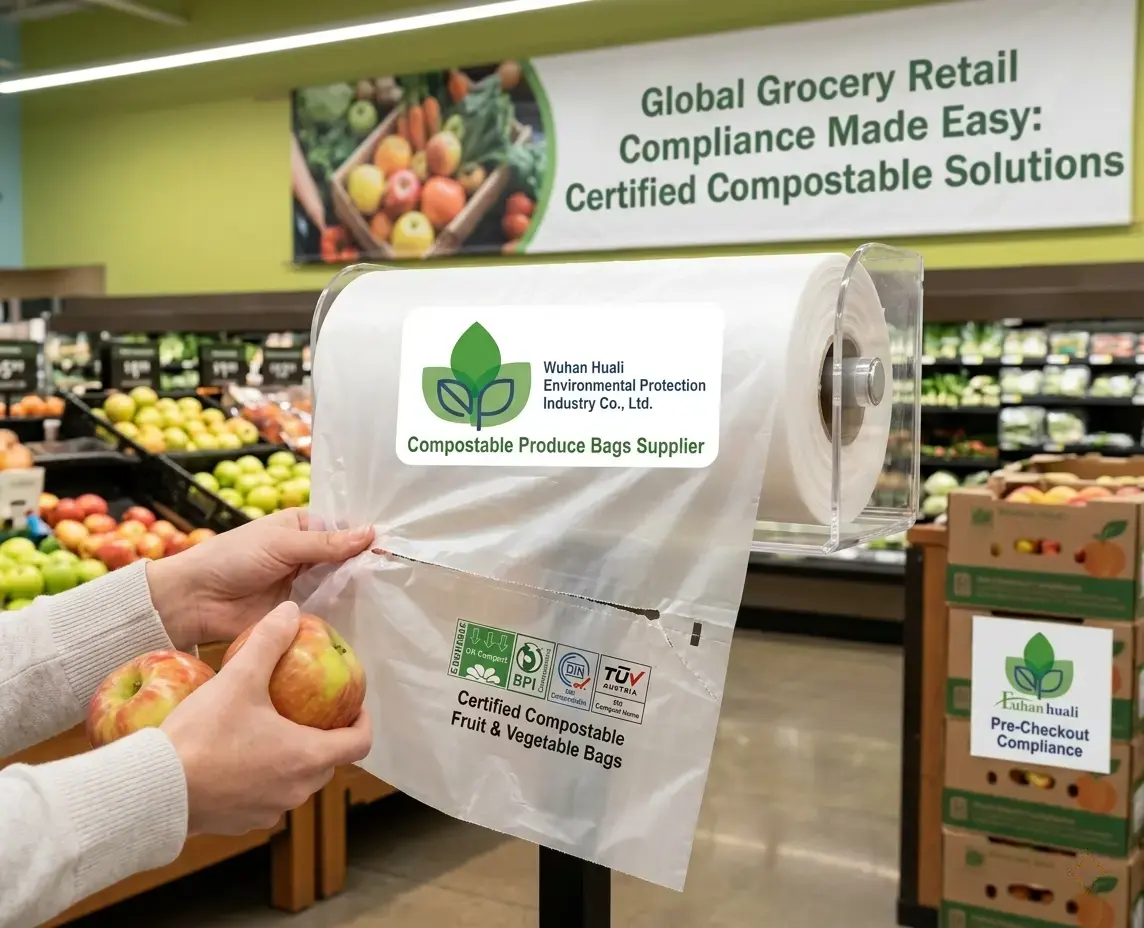
Bron gecertificeerde composteerbare groente- en fruitzakjes groothandel. SB 1046-conform, FDA-voedselveilig, ASTM D6400 + BPI-gecertificeerd. Ontvang de leverancierschecklist en een gratis offerte.
Leverancier van composteerbare zakken voor groenten en fruit: hoe u FDA-veilige, gecertificeerde composteerbare fruit- en groentezakken inkoopt voor de levensmiddelenretail
Door Janet Liu · 15-05-2026 · Leestijd: 7 min
Inhoudsopgave
California SB 1046: de wet die de inkoop van zakken voor groenten en fruit veranderde
Het certificeringspakket: waaraan uw zakken voor groenten en fruit moeten voldoen
SGS-testen en laboratoriumrapporten van derden: wat kopers moeten eisen
Hoe u een leverancier van composteerbare zakken voor groenten en fruit beoordeelt
Als u pre-checkout-zakken inkoopt voor een Amerikaanse supermarktketen, een biologisch foodmerk of een retailer in verse groenten en fruit, is het nalevingslandschap in januari 2025 wezenlijk veranderd — en in 2026 komt daar nog een laag bij. Leveranciers van composteerbare zakken voor groenten en fruit zijn inmiddels essentiële partners in uw toeleveringsketen, niet langer optionele leveranciers. California's SB 1046 verplicht dat alle pre-checkout-zakken — de zakken op rol voor los fruit, groenten, vlees, noten en bulkgoederen — ofwel gecertificeerd composteerbaar ofwel gerecycled papier moeten zijn. Conventionele plastic zakken voor groenten en fruit zijn verdwenen uit de Californische schappen, en meer staten zullen naar verwachting volgen. Deze gids geeft inkoopmanagers precies wat zij nodig hebben om de juiste leverancier te beoordelen, te kwalificeren en te onboarden.
1. California SB 1046: de wet die de inkoop van zakken voor groenten en fruit veranderde
California's SB 1046 is de fundamentele nalevingsdrijfveer voor elke Amerikaanse supermarktretailer die in 2026 zakken voor groenten en fruit inkoopt. SB 1046 prohibits stores from providing a pre-checkout bag that is not a recycled paper bag or compostable plastic bag. The law took effect January 1, 2025, meaning covered retailers are already required to comply.
The new law defines a "pre-checkout bag" as "a bag provided to a customer before the customer reaches the point of sale, that is designed to protect a purchased item from damaging or contaminating other purchased items in a checkout bag, or to contain an unwrapped food item, such as, but not limited to, loose produce, meat or fish, nuts, grains, candy, and bakery goods."
Stores that may only provide customers with compostable or recycled paper pre-checkout bags include: full-line, self-service retail stores with gross annual sales of at least $2 million that sell a line of dry groceries, canned goods, or nonfood items, and some perishable items; large retail stores with a pharmacy that have at least 10,000 square feet of retail space and that generate sales or use tax; and convenience stores, food marts, or liquor stores that are engaged in the retail sale of a limited line of goods, generally including milk, bread, soda, and snack foods, and that hold a Type 20 or Type 21 license.
In California, many of the plastic produce bags used for fresh fruits and vegetables while shopping in stores end up in compost waste streams and thereby contaminate municipal compost facilities. This type of contamination not only increases microplastics in compost, but also leads to increased handling costs which in turn leads to higher rates for consumers. SB 1046 was designed directly to address this problem by replacing conventional plastic with certified compostable alternatives that can safely enter the organic waste stream.
De politieke houdbaarheid van de wet is van belang voor inkoopplanning. A challenge, AB 2226, would have repealed SB 1046 outright — but the bill was withdrawn in late April because stakeholders across the system made clear they did not want plastic produce bags back on shelves. AB 2226 being withdrawn signaled that California stakeholders do not want conventional plastic bags back in the produce aisles. Certified compostable produce bags are here to stay.
Belangrijkste conclusie: California SB 1046 (van kracht sinds januari 2025) verbiedt conventionele plastic pre-checkout-zakken bij alle grote supermarktretailers. Gecertificeerde composteerbare zakken voor groenten en fruit zijn een van slechts twee conforme alternatieven. Een poging tot intrekking werd in 2026 ingetrokken, wat de permanentie van de wet bevestigt. Inkoopteams moeten dit behandelen als een langetermijnvereiste voor inkoop, niet als een tijdelijke aanpassing.
2. Wat zijn composteerbare fruit- en groentezakken?
Composteerbare fruit- en groentezakken — ook wel pre-checkout-zakken of groentezakken op rol genoemd — zijn de dunne, geperforeerde zakken op rol die op dispensers in het hele groenteschap worden geplaatst. De composteerbare versie vervangt conventionele LDPE- of HDPE-folie door een blend van PLA/PBAT/maïszetmeel:
PLA (polymelkzuur) — plantaardig, zorgt voor helderheid, stijfheid en bedrukbaarheid; stelt shoppers in staat het product door de zak te zien
PBAT (polybutyleenadipaat-tereftalaat) — flexibele co-polyester die de scheurweerstand biedt die nodig is om zakken te vullen met zware of scherpe producten
Maïszetmeel — een natuurlijke vulstof die de grondstofkosten verlaagt en de biologische afbraak onder composteeromstandigheden versnelt
Bij ECOKEEP (Wuhan Huali) hebben we deze blend meer dan 24 jaar ontwikkeld. Als opsteller van 15 Chinese nationale normen voor biologisch afbreekbare materialen en lid van de ASTM D20-commissie optimaliseert ons R&D-team de PLA/PBAT-verhoudingen om de foliehelderheid te bereiken die kopers van groenten en fruit verwachten en de structurele integriteit die rol-dispenserformaten vereisen. Het resultaat is een zak die presteert in het groenteschap en aan het einde van zijn levensduur schoon composteert.
Een belangrijke ontwerpspecificatie die in de Californische wet is vastgelegd: the 15-inch opening width SB 1046 specifies wasn't arbitrary — it was designed to let the bag have a second life as a kitchen food scrap caddy liner. Sixty-three percent of respondents in a 2026 California household survey said they reuse compostable produce bags for food scrap collection — confirming that these bags serve dual duty in the state's SB 1383 organics infrastructure.
3. FDA-veiligheid bij voedselcontact: waarom dit niet onderhandelbaar is voor zakken voor groenten en fruit
Composteerbaarheidscertificering en veiligheid bij voedselcontact zijn twee afzonderlijke nalevingsvereisten — en beide zijn verplicht voor zakken voor groenten en fruit die in de Amerikaanse levensmiddelenretail worden gebruikt. Veel kopers richten zich uitsluitend op composteerbaarheidscertificering en zien documentatie over veiligheid bij voedselcontact over het hoofd. Dat is een kostbare fout.
Do compostable materials require FDA approval? Yes. All packaging that comes into contact with food must comply with FDA food-contact regulations, regardless of sustainability claims.
Ingredients added directly to food and substances that come into contact with food are generally held to the same safety standard — there must be a reasonable certainty of no harm under the conditions of intended use. For compostable produce bags, this means the PLA/PBAT/starch film, inks, adhesives, and any coatings must all be evaluated for migration safety — not just the base resin.
Food-safe packaging is defined by its inert behavior under intended use conditions. This means the material must not chemically react with food, alter taste or odor, or allow harmful substances to migrate into the food during normal handling, storage, or heating.
Materials commonly used in sustainable packaging, such as PLA can qualify as food-safe, but only after meeting specific FDA standards. These standards evaluate purity, composition, and performance under defined temperature and moisture conditions. Importantly, being natural or plant-based does not automatically make a material food-safe.
The Federal Food, Drug, and Cosmetic Act (FFDCA) is the key piece of legislation covering food contact materials (FCM) in the U.S. It is administered by the Food and Drug Administration (FDA). Regulations pertaining to FCM can principally be found in Title 21 of the Code of Federal Regulations (CFR). For compostable film bags, the relevant sections include 21 CFR 176.170 (components of paper and paperboard in contact with aqueous and fatty foods) and related polymer regulations.
PFAS-naleving voegt nog een laag toe. Per- and polyfluoroalkyl substances (PFAS) in food contact materials have increasingly been regulated across the U.S. due to their toxic effects and negative impacts on the environment. The use of PFAS in FCM is regulated by several jurisdictions across the U.S. For example, California and New York outlaw PFAS in food packaging made mostly of paper, paperboard, or derived from plant fibers. Any compostable produce bag supplier must confirm their film is PFAS-free.
Belangrijkste conclusie: FDA-naleving bij voedselcontact en composteerbaarheidscertificering zijn onafhankelijke vereisten. Een zak kan gecertificeerd composteerbaar zijn maar toch niet voldoen aan de FDA-normen voor voedselcontact als de harsen, inkten of coatings niet-goedgekeurde stoffen bevatten. Vraag uw leverancier altijd zowel het composteerbaarheidscertificaat ALS een FDA/SGS-testrapport over migratie bij voedselcontact op.
4. Het certificeringspakket: waaraan uw zakken voor groenten en fruit moeten voldoen
Voor composteerbare fruit- en groentezakken die in de Amerikaanse levensmiddelenretail worden verkocht, is het vereiste certificeringspakket complexer dan voor checkout-zakken. Dit moet u per markt verifiëren:
Californië (SB 1046): Products sold in California labeled as "compostable" must have certification that they meet at least one applicable standard specification from an approved third-party certification entity. Any product sold in California must meet ASTM D6400 and D6868 specification standards for commercial composting, or TÜV Austria's OK Compost Home standards for home composting. BPI certification satisfies the ASTM D6400 requirement and is the most widely recognized third-party mark in the U.S. market.
Aanvullende Californische vereiste vanaf januari 2026: This requirement applies on and after January 1, 2024. On and after January 1, 2026, the product must also be an allowable agricultural organic input under the requirements of the United States Department of Agriculture. This USDA NOP requirement means compostable bags used in California must now be verified as suitable for agricultural organic inputs — a stricter standard than compostability alone.
Kleur en etikettering: Compostable plastic bags must be eligible to be labeled with the terms "compostable" or "home compostable" per California law, and must use green, beige, or brown tinting or color schemes.
EU-markten: EN 13432-certificering (TÜV Austria OK Compost INDUSTRIAL of DIN CERTCO Seedling) is vereist voor producten die als composteerbaar op de markt worden gebracht onder de Richtlijn verpakkingen en verpakkingsafval.
Australië: AS 4736 (industriële compostering) is de primaire norm. AS 5810 dekt thuiscompostering. Meerdere Australische staten staan composteerbare zakken die zijn gecertificeerd volgens AS 4736, EN 13432 of ASTM D6400 expliciet toe als alternatief onder hun plasticzakkenverboden.
ECOKEEP's Composteerbare zakken voor groenten en fruit dragen EN 13432, ASTM D6400, BPI, OK Compost en OK Compost HOME (AS 5810) — het volledige certificeringspakket dat nodig is voor conforme inzet in Californië, de EU en Australië vanuit één product-SKU. Onze zakken worden geproduceerd in groene, beige of naturel tinten om te voldoen aan de kleursignaalvereiste van Californië.
5. SGS-testen en laboratoriumrapporten van derden: wat kopers moeten eisen
Voor zakken voor groenten en fruit die direct met voedsel in contact komen, vormt testen door een laboratorium van derden de bewijsbasis van uw leverancierskwalificatieproces. Verified certifications help brands strengthen credibility by providing third-party evidence supporting compostability or food-contact safety claims.
FDA compliance is not the same as compostability certification. A product may be compostable but still require food-contact safety verification. The two documents address different risks and must both be on file before bulk order placement.
Importers should always request FDA, LFGB, or EU 10/2011 food contact reports from suppliers. A credible supplier will provide documents from recognized labs. Ensure reports come from ISO/IEC 17025 accredited laboratories such as SGS or Intertek.
Reports should cover all food types — aqueous, fatty, acidic, and alcoholic — to ensure safety across use cases. For compostable produce bags, the minimum scope should include migration testing for heavy metals, overall migration limits, and specific migration limits for substances regulated under 21 CFR.
Bij ECOKEEP leveren we een SGS-testrapport over voedselcontact dat migratietesten met meerdere voedsel simulantia omvat, als onderdeel van ons standaarddocumentatiepakket voor leveranciers. Brands that clearly communicate food-safety compliance strengthen credibility and reduce the risk of greenwashing claims. Clear documentation, supplier guarantees, and test reports support responsible marketing and informed decision-making across the supply chain. Our test reports are available to qualified buyers before order commitment.
6. Etiketteringsvereisten op de zak volgens SB 1046
Composteerbare zakken voor groenten en fruit moeten voldoen aan de specifieke etiketteringsregels van Californië om wettelijk conform te zijn. Verkeerd artwork betekent non-conformiteit, zelfs als de folie zelf gecertificeerd is. Dit vereisen SB 1046 en gerelateerde Californische composteerbaarheidswetten op de zak:
Certificeringsmerk — een BPI-logo of OK Compost-merk van een goedgekeurde certificeringsinstantie van derden
Het woord „COMPOSTABLE” — mag volgens de Californische wet op de zak staan; geen verboden termen zoals „biodegradable”, „degradable” of „decomposable”.
Kleursignaal —
Composteerbare plastic zakken moeten groene, beige of bruine tinten of kleurenschema's gebruiken om visuele differentiatie van conventionele plastic zakken mogelijk te maken
Minimale openingsbreedte van 15 inch — verplicht door SB 1046 om het secundaire gebruik van de zak als binnenvoering voor een bakje voor voedselresten onder SB 1383 mogelijk te maken
Geen recycling-symbool — het symbool met de achtervolgende pijlen mag niet voorkomen, omdat het recycleerbaarheid in standaard plasticstromen impliceert
ECOKEEP biedt volledige bedrukking van het oppervlak met watergedragen inkten. Ons interne artworkteam verwerkt alle verplichte etiketteringselementen — BPI-merk, Californië-conforme kleurtinting, certificeringslogo's en verwijderingsinstructies — in uw winkelmerkzakontwerp vóór productie in bulk. Retailers die voor distributie in meerdere staten inkopen, kunnen één master-artwork aanvragen dat tegelijk voldoet aan de etiketteringsvereisten van Californië, Washington en de EU.
7. Hoe u een leverancier van composteerbare zakken voor groenten en fruit beoordeelt
In de beslissingsfase komt leverancierskwalificatie neer op documentatiediepgang, productieconsistentie en transparantie in de toeleveringsketen. Importers should review certificate validity dates, issuing organizations, laboratory authenticity, and product scope. Use this structured checklist:
ASTM D6400 + BPI-certificering — bevestig een actuele, nog geldige BPI-verklaring; BPI-certificaten worden tweejaarlijks vernieuwd. Verifieer dat het certificaat expliciet het product zak voor groenten en fruit dekt (niet alleen een gerelateerde SKU)
EN 13432-certificering — vereist voor toegang tot de EU-markt; uitgegeven door TÜV Austria of DIN CERTCO
SGS- of gelijkwaardig testrapport over migratie bij voedselcontact — van een laboratorium dat is geaccrediteerd volgens ISO/IEC 17025, met waterige, vet-, zure en alcoholische voedsel simulantia; moet PFAS-vrije status bevestigen
FDA-nalevingsdocumentatie — leveranciersverklaring of testrapport dat bevestigt dat basishars en inkten voldoen aan de 21 CFR-voorschriften voor gebruik bij voedselcontact
USDA NOP-landbouwkundige geschiktheid voor biologische input — vereist voor naleving van California SB 1046 vanaf januari 2026
ISO 9001 + ISO 14001-managementsystemen — verifieerbare certificering voor kwaliteits- en milieumanagement, auditbaar door het team van de koper zelf
Verticale toeleveringsketen — leveranciers die hun eigen hars compounderen en hun eigen folie extrusie doen, verminderen variabiliteit tussen batches. ECOKEEP beheert een complete keten van materiaal tot eindproduct binnen een industrieel park van 30.000 m² met een jaarlijkse capaciteit van meer dan 8.000 ton
Compatibiliteit met rolformaat — bevestig vóór bestelling in bulk dat kerngrootte en perforatie-afstand overeenkomen met de specificaties van uw bestaande dispensers in de winkel
Mogelijkheid tot maatwerk bedrukking — maatwerkbedrukking met watergedragen inkt met kleurmatchende branding en ingebouwde nalevingsetiketten (BPI-merk, kleursignaal, composteerbaarheidsclaim) in één productierun
Productie-/levertijd en MOQ — ECOKEEP's standaard productie-/levertijd is 3 weken voor orders van 10 ton op FOB Shanghai- of FOB Wuhan-voorwaarden. Betaling: 30% T/T vooraf, restbetaling vóór verzending
Bevestiging van houdbaarheid — ECOKEEP's composteerbare zakken voor groenten en fruit behouden een houdbaarheid van 12 maanden in verzegelde originele kartonverpakking, droog en uit direct zonlicht bewaard, wat categorie-inkopers een adequate seizoensbuffer geeft
Als China's eerste fabrikant van biologisch afbreekbare draagtassen en opsteller van 15 nationale normen voor biologisch afbreekbare materialen, ECOKEEP levert sinds 2002 gecertificeerde composteerbare zakken aan supermarktretailers en biologische foodmerken in de VS, de EU en Australië. We begrijpen de technische vereisten achter elke certificering in onze documentatiestack — omdat ons team heeft meegewerkt aan het opstellen van de normen. Vraag ons volledige pakket certificeringen en testrapporten aan voordat u uw eerste bestelling plaatst.
FAQ
Wat is het verschil tussen een composteerbare zak voor groenten en fruit en een biologisch afbreekbare zak voor groenten en fruit?
AB 1201 prohibits any products sold in California from being labeled "compostable" or "home compostable" unless they meet very strict criteria. Strict labeling standards for compostable products will lessen confusion among consumers and businesses over what products are compostable and how they should be discarded. "Biodegradable" without a third-party certification does not satisfy California SB 1046. Only bags certified to ASTM D6400 (or equivalent) by an approved third-party entity qualify as legally compliant compostable pre-checkout bags.
Vereisen composteerbare zakken voor groenten en fruit FDA-goedkeuring voor voedselcontact?
Yes. All packaging that comes into contact with food must comply with FDA food-contact regulations, regardless of sustainability claims. Compostability certification alone does not satisfy FDA food-contact requirements. Buyers must request a separate SGS or equivalent migration test report from their supplier confirming compliance with 21 CFR regulations and PFAS-free status.
Welke boetes gelden als een supermarkt niet-conforme zakken voor groenten en fruit verstrekt?
Fines for violations are tiered. For a first offense, businesses may incur a fine of up to $500. A second violation can result in a $1,000 penalty, with subsequent violations reaching $2,000 per occurrence. This structure encourages businesses to rectify compliance lapses swiftly. Cities, counties, and the Office of the Attorney General have the authority to enforce the statutory requirements for pre-checkout bags and recycled paper carryout bags.
Kunnen composteerbare zakken voor groenten en fruit in de groenafvalbak langs de stoep in Californië?
Most jurisdictions in California do not allow compostable plastic film bags to be placed in organic waste collection bins or carts. Contact your local recycler or curbside program to learn more about the recycling and disposal options in your jurisdiction for managing compostable pre-checkout bags at the end of their useful life. End-of-life disposal guidance should be included in the on-bag artwork to inform consumers appropriately.
Klaar om een leverancier van gecertificeerde composteerbare zakken voor groenten en fruit te kwalificeren?
ECOKEEP levert composteerbare fruit- en groentezakjes met ASTM D6400- + BPI- + EN 13432-certificering, inclusief SGS-testrapporten voor voedselcontact, etikettering conform California SB 1046 en een productie-/levertijd van 3 weken. Vraag vandaag nog ons volledige documentatiepakket en een gratis monster aan.
Vraag een gratis offerte aanReferenties
Californians Against Waste — SB 1046 (Eggman & Gonzalez): Plastic Produce Bags
CalRecycle — Bag Requirements at Grocery and Retail Stores (SB 1046 & SB 1053 Guidance)
Packaging Law — California to Ban Plastic Bags for Produce: SB 1046 Overview
LegalClarity — California SB 1046: Bag Regulations and Compliance Guide
BioCycle — Why California's Next Compostable Packaging Bill Could Stall SB 1383 (May 2026)
Surfrider Foundation California — California Plastic Pollution Reduction Laws Overview
ASTM International — D6400-21 Standard Specification for Compostable Plastics