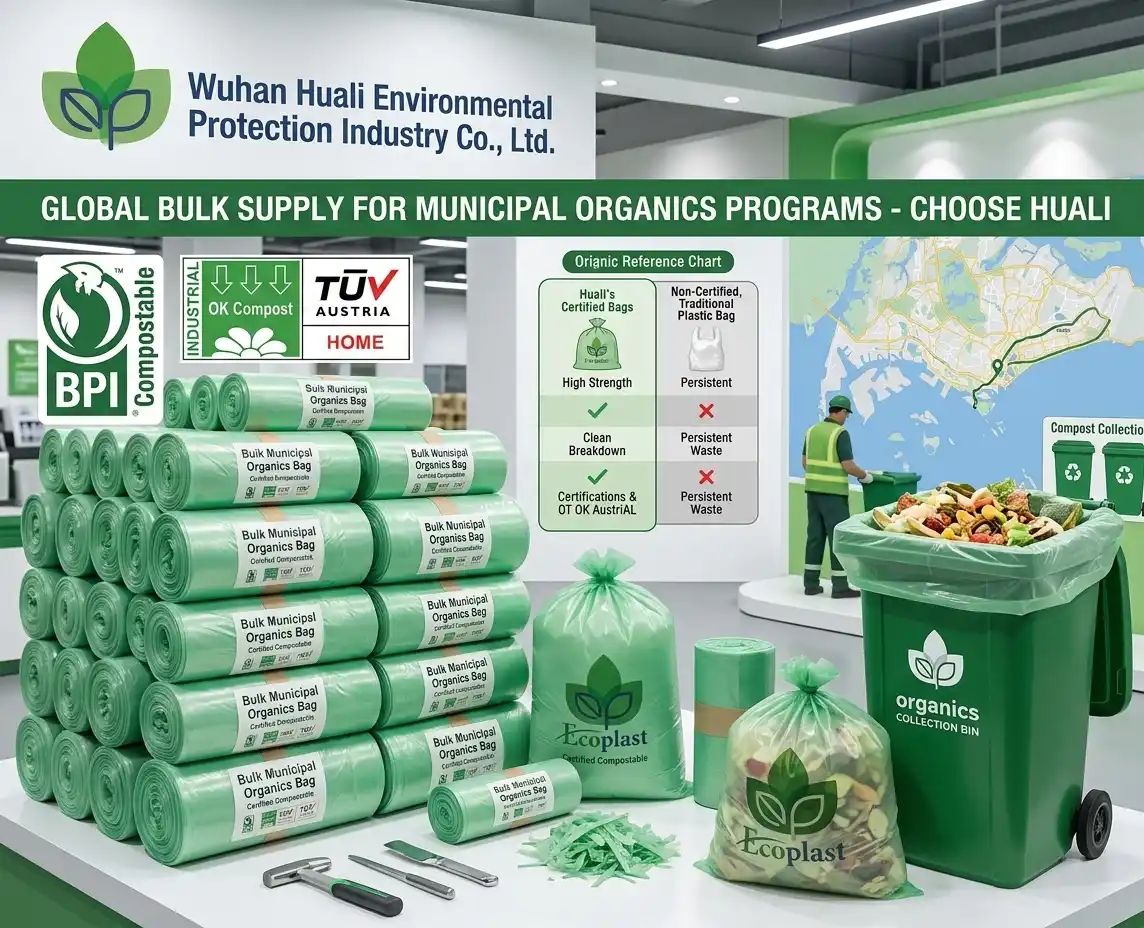
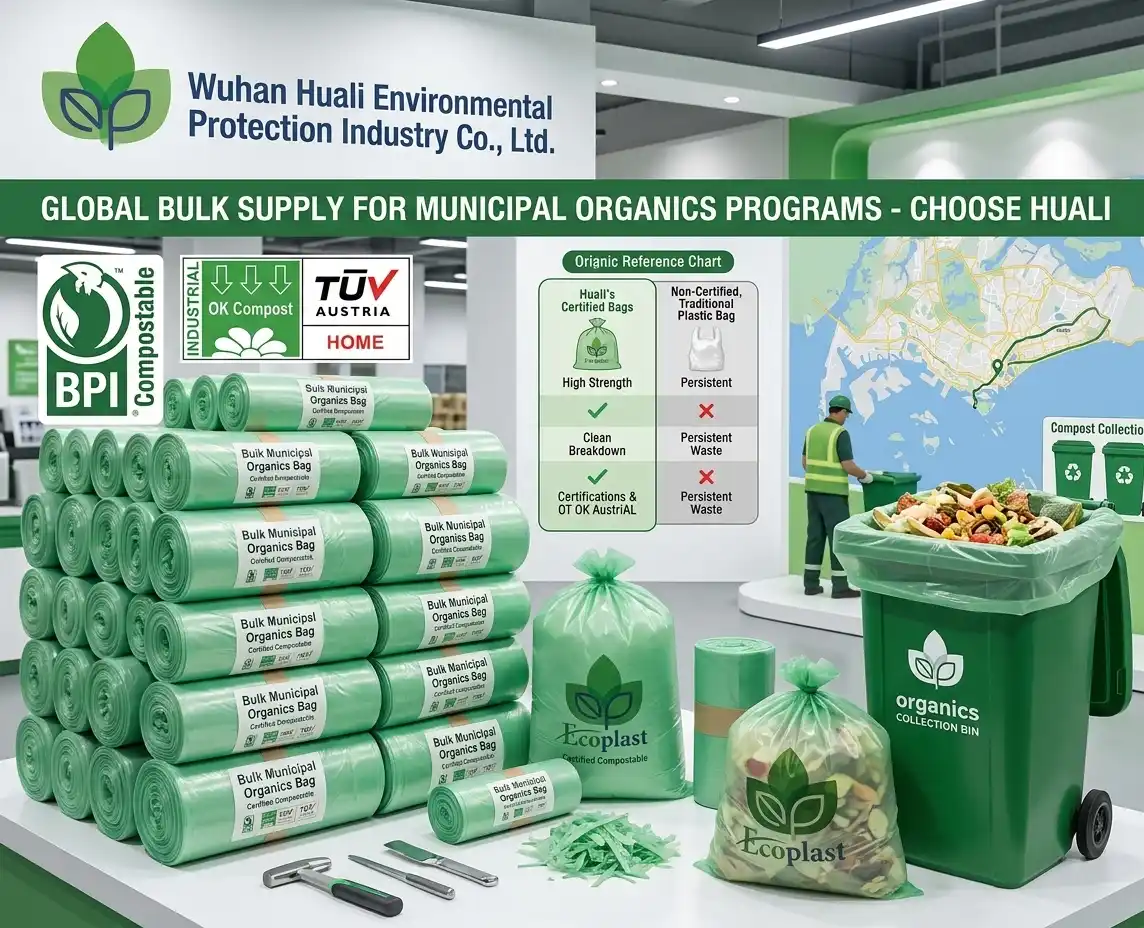
Koop gecertificeerde composteerbare vuilniszakken in bulk. BPI + OK Compost gecertificeerd, lekvrij, capaciteit 8.000 MT/jaar, productie-/levertijd 3 weken. Offerte gratis beschikbaar.
Fabrikant van composteerbare vuilniszakken: de B2B-inkoopgids voor gecertificeerde, lekbestendige afvalzakken voor gemeentelijke en commerciële programma's
Door Janet Liu · 29 mei 2026 · Leestijd: 7 min
Inhoudsopgave
Waarom certificering het eerste filter is bij het inkopen van composteerbare afvalzakken
De opkomst van gemeentelijke GFT-programma's: wat de B2B-vraag in 2026 aandrijft
De echte prestatietest: lekbestendigheid, draagkracht en sealontwerp
Het certificeringspakket: BPI, OK Compost en wat elke markt vereist
Maatbereik en toepassingsgids voor gemeentelijke en commerciële programma's
Hoe u een fabrikant van composteerbare vuilniszakken op commerciële schaal kwalificeert
Voor inkoopteams van gemeentelijke GFT-programma's, beheermaatschappijen van vastgoed en merken van afvalzakken met merklabel is het inkopen van composteerbare vuilniszakken bij de juiste fabrikant een beslissing met hogere inzet dan het lijkt. De verkeerde keuze — zakken die lekken, niet door de acceptatietests van composteerders komen of verlopen certificeringen hebben — kan een heel GFT-programma besmetten, regelgevende boetes uitlokken en het vertrouwen van de gemeenschap in de infrastructuur voor afvalscheiding aantasten. Deze gids biedt B2B-kopers een gestructureerd kader om groothandelsleveranciers van composteerbare vuilniszakken te beoordelen aan de hand van de technische, regelgevende en operationele normen die gemeentelijke en commerciële programma's in 2026 daadwerkelijk vereisen.
1. Waarom certificering het eerste filter is bij het inkopen van composteerbare afvalzakken
De markt voor composteerbare afvalzakken heeft een besmettingsprobleem — en dat begint stroomopwaarts, niet bij de composteerfaciliteit. BPI certification guarantees a product meets strict compostability standards, while "biodegradable" has no consistent definition or timeframe. Yet the market is still flooded with bags carrying "biodegradable" or "eco-friendly" claims backed by nothing more than additive chemistry that fails composting facility intake tests.
De gevolgen zijn meetbaar. More than 40% of municipal solid waste is organic material that could be composted. Yet conventional plastic bin liners contaminate compost streams and take centuries to break down. When uncertified bags — including those with misleading "biodegradable" labels — enter organics streams, composting facilities must screen them out, increasing handling costs and degrading compost quality.
The greatest hurdle is widespread trust and cooperation across the entire supply chain. Reasons for that broken trust stem from a lack of clarity about the fundamental characteristics and benefits of compostable packaging and misinformation about what is truly compostable, with uncertified products creating distrust on both the consumer and composter side.
Certificering is geen marketinglaag — het is de operationele basis. BPI is the leading authority on compostable products and packaging in North America, thanks to its commercial compostability certification program that has been operating for over 25 years. That program is the most reliable, widely-recognized third-party verification of whether or not an item meets ASTM's compostability standards — a metric required by every U.S. state that has regulatory language around the definition of compostability.
Belangrijkste conclusie: Certificering door een derde partij — BPI voor Noord-Amerika, OK Compost voor Europa — is de minimale kwalificatiedrempel voor composteerbare afvalzakken die in gemeentelijke GFT-programma's terechtkomen. Inkoopteams moeten elke leverancier uitsluiten die geen actueel, geldig BPI- of TÜV Austria-certificaat kan overleggen voor de specifieke product-SKU die wordt besteld.
2. De opkomst van gemeentelijke GFT-programma's: wat de B2B-vraag in 2026 aandrijft
De vraag naar groothandel in gecertificeerde composteerbare afvalzakken wordt gedreven door een versnellende golf van verplichte GFT-scheiding in de VS, EU en Australië. De regelgevende druk is structureel en meervoudig juridisch — niet één wet, maar een cascade van mandaten op staats-, county- en stadsniveau.
In Californië, as a result of SB 1383, the City is required to provide three-container solid waste service — garbage, recycling, and organics — to all residents and businesses. This three-bin mandate, rolling out across thousands of California jurisdictions, creates direct procurement demand for certified compostable bag liners that are accepted at receiving composting facilities.
Washington State scherpt de eisen voor GFT-scheiding aan naast zijn regelgeving voor plastic zakken. In 2026, the waste threshold decreases to include any business that produces over 96 gallons of organic waste per week. Seattle County requires all single-family and multifamily residences and commercial businesses to separate food waste and subscribe to compost collection services.
Minnesota bouwt zijn eigen certificeringsinfrastructuur verder uit. A compostable labeling law went into effect in January 2025, expanding an existing law for compostable bags for yard debris to include packaging and food service ware. The label bill is intended to reduce confusion around what is compostable, remove terms like "biodegradable" that don't have standards to be measured against, and ultimately prevent misleading claims and decrease contamination upstream. Beginning in 2026, a certification requirement will back up the ASTM standards.
Op countyniveau nemen de programma's in aantal toe. Beltrami County's organics program has been upgraded, with six regional counties introducing specially designed bags to hold organic materials, which will be separated and turned into compost. Each new program creates a direct procurement tender for certified compostable waste bags at institutional volumes.
3. De echte prestatietest: lekbestendigheid, draagkracht en sealontwerp
De grootste operationele zorg van gemeentelijke programmamanagers en kopers in vastgoedbeheer: houden de zakken vochtig voedselafval zonder te lekken tijdens de inzameling? Het is een legitieme zorg — en het antwoord hangt volledig af van filmtechniek en sealontwerp, niet alleen van materiaalcertificering.
Made from renewable, plant-based biopolymers, certified compostable bags are 100% plastic-free and contain no polyethylene. With durable tear-resistance and leak-proof strength, they handle everything from fruit and vegetable scraps to heavy leftovers without the mess.
Bij ECOKEEP (Wuhan Huali) zijn onze composteerbare vuilniszakken ontworpen met een PLA/PBAT/maïszetmeelmengsel dat is geoptimaliseerd voor het containen van nat afval. De kritische specificaties zijn:
Filmdikte — minimaal 15 micron voor standaard keukenafvalbakzakjes; 20–25 micron voor zwaar GFT- en algemeen afval; 30+ micron voor commerciële en tuinafvalprogramma's
Type seal — stervormige seal (bodemsluiting zonder verticale zijnaden) is de industriestandaard voor lekbestendigheid bij vuilniszakformaten. Onze stervormig gesealde ontwerpen elimineren de zwakke hoekpunten van zijsealconstructies
Sluitingsopties — vlakke open bovenkant (standaard rolzak), trekkoord (premium residentieel en commercieel) en bindhandgreep (institutioneel) beschikbaar; trekkoordontwerpen bieden de hoogste weerstand tegen morsen tijdens optillen en dragen
PBAT-aandeel — een hoger PBAT-gehalte verhoogt de rek bij breuk, de kritische maat voor perforatieweerstand wanneer zakken in contact komen met scherp voedselafval zoals botten, schelpen of citruschillen
Als China's eerste fabrikant van biologisch afbreekbare koeriers- en draagtassen — actief sinds 2002 — heeft ons R&D-team het PLA/PBAT-mengsel gedurende 24 jaar verfijnd in productieruns met grote volumes. In onze ervaring, met een jaarlijkse productie van meer dan 8.000 metrische ton, is de meest voorkomende oorzaak van zakfalen in de praktijk een te geringe filmdikte ten opzichte van de afvaldichtheid, niet de materiaalsamenstelling. Wij specificeren minimumdiktes op basis van de toepassing tijdens de fase van monstergoedkeuring.
Belangrijkste conclusie: Stervormig gesealde composteerbare vuilniszakken met een filmdikte van ≥20 micron bieden de lekbestendigheid die nodig is voor nat voedselafval in gemeentelijke ophaal- en commerciële keukenprogramma's. Specificeer altijd het sealtype, de filmdikte en het sluitingsformaat — niet alleen de afmetingen van de zak — wanneer u een inkooporder bij uw fabrikant plaatst.
4. Het certificeringspakket: BPI, OK Compost en wat elke markt vereist
Voor composteerbare afvalzakken die in B2B-toeleveringsketens in Noord-Amerika, Europa en Australië terechtkomen, verschilt het vereiste certificeringspakket per bestemming. Hier is de uitsplitsing per markt:
Noord-Amerika (VS en Canada): All products certified by BPI meet ASTM standards for compostability, are subject to eligibility criteria around the connection to food scraps and yard trimmings, meet limits for total fluorine (PFAS), and must display the BPI Certification Mark. BPI certification based on ASTM D6400 is the recognized standard. BPI's standard for fluorinated chemicals (PFAS) went into effect on January 1, 2020. Products may no longer be claimed as BPI-certified unless they meet all conditions of the rule, including no intentionally-added fluorinated chemicals, a test report showing less than 100 ppm total organic fluorine, and a technical review of the formulation.
Europese Unie: EN 13432-certificering is verplicht voor producten die als composteerbaar op de markt worden gebracht onder de Richtlijn verpakking en verpakkingsafval. TÜV Certified Compostable products are independently tested to meet Europe's EN 13432 compostability standard. The OK Compost INDUSTRIAL mark (TÜV Austria) is the most widely recognized third-party label across EU markets. The Seedling logo (DIN CERTCO / European Bioplastics) is also widely accepted, and proves a product is certified industrially compostable according to EN 13432 — a 3rd party certification by TÜV AUSTRIA authorized by European Bioplastics, usually certified in addition to OK Compost Industrial to ensure compostable certification throughout the European market.
Australië: AS 4736 regelt industriële composteerbaarheid; AS 5810 regelt thuiscomposteerbaarheid. Meerdere Australische staten accepteren expliciet composteerbare zakken met certificering volgens AS 4736, EN 13432 of ASTM D6400 als nalevingsalternatieven onder hun wetgeving voor plastic zakken en GFT-afval.
Minnesota en uitgebreide eisen van Amerikaanse staten: Certified compostable products must display a certification logo indicating compliance with the ASTM D6400 standard, verified by a third-party independent body (BPI and CMA). They must have a uniform color — green, beige, or brown — and be labeled "compostable" on one or both sides of the bag, meeting industry standards for quick identification in public sorting areas and processing facilities.
ECOKEEP's Composteerbare vuilniszakken en Composteerbare afvalzakken beschikken over het volledige certificeringspakket: EN 13432, ASTM D6400, BPI, OK Compost INDUSTRIAL en OK Compost HOME (AS 5810). Onze managementsystemen volgens ISO 9001, ISO 14001 en ISO 45001 waarborgen dat de certificaatgeldigheid voor alle productiebatchs behouden blijft in onze fabriek van 30.000 m² in Wuhan.
5. Acceptatie door composteerfaciliteiten: de over het hoofd geziene variabele bij het inkopen van bulkzakken
Gemeentelijke inkopers richten zich vaak uitsluitend op productcertificering en zien een parallelle vereiste over het hoofd: of de specifieke gecertificeerde zak wordt geaccepteerd door de composteerfaciliteiten die hun rechtsgebied bedienen. Dit zijn niet altijd hetzelfde.
Do all composting facilities accept BPI-certified products? Most commercial composting facilities accept BPI-certified products, but acceptance can vary by location. Always check with your local facility before disposal.
Sommige rechtsgebieden gaan verder. While well-intentioned, eco-friendly plastic bags do not break down fast enough for a large-scale composting operation. They take much longer than the normal compost cycle of six weeks. Facilities with accelerated processing cycles — particularly in-vessel and tunnel composting operations — may require bags that disintegrate faster than the 12-week EN 13432 or ASTM D6400 threshold.
The Compost Manufacturing Alliance (CMA) goes beyond the lab — combining ASTM testing with field trials at commercial compost facilities. Composters value this approach precisely because it tests bags under real operating conditions, not just controlled laboratory environments. For municipal procurement teams, CMA certification provides an additional layer of confidence beyond BPI alone.
Beste praktijk voor institutionele inkopers: neem contact op met de composteerfaciliteit(en) die de organische afvalstroom zal ontvangen en bevestig hun lijst met geaccepteerde zakken voordat u een bulkopdracht uitschrijft. Verstrek de BPI- en EN 13432-certificaatnummers van uw shortlist van leveranciers voor directe verificatie. ECOKEEP kan een volledig documentatiepakket leveren — inclusief certificaatnummers en laboratoriumrapport-identificaties — voor voorafgaande goedkeuring door de faciliteit voordat u de bulkorder plaatst.
6. Maatbereik en toepassingsgids voor gemeentelijke en commerciële programma's
Composteerbare vuilniszakken voor B2B-programma's beslaan een breed scala aan maten en uitvoeringen. Het afstemmen van de juiste specificatie op de toepassing voorkomt de meest voorkomende problemen in de praktijk: zakken die te klein zijn voor de werkelijke afvalvolumes, of folie die te dun is voor zware commerciële lasten.
2–4 gallon (ca. 7,5–15 liter) caddy-voeringzakken voor aanrecht — voor keukenafvalemmers bij huishoudens in driestroomssystemen aan de stoeprand; sterzegel, groen getint, minimaal 12–15 micron
8–13 gallon (ca. 30–50 liter) voeringzakken voor keukenemmers — standaard formaat voor huishoudelijke emmers onder het aanrecht; sterzegel of trekkoord; 15–20 micron; het meest voorkomende formaat in gemeentelijke woonprogramma's
23–33 gallon (ca. 87–125 liter) voeringzakken voor grote keuken-/kantooremmers — commerciële keukens, restaurants en institutionele foodservice; trekkoord of vlakke open bovenkant; 20–25 micron
39–55 gallon (ca. 148–208 liter) zware voeringzakken — commerciële inzameling van organisch afval, tuinafval en grootschalige institutionele programma's; sterzegel of zijvouw; 25–35 micron
These compost bags come in a variety of sizes for different applications, from countertop to commercial kitchens and farms, and are great for both home and business use. ECOKEEP supports fully custom dimensions and thickness specifications — including paper core roll formats for institutional dispensing systems — across all size categories.
7. Hoe u een fabrikant van composteerbare vuilniszakken op commerciële schaal kwalificeert
In de beslissingsfase vereist de kwalificatie van een leverancier van gecertificeerde composteerbare afvalzakken documentatiediepgang, verificatie van de productiecapaciteit en goedkeuring van fysieke monsters. Gebruik deze gestructureerde checklist:
BPI-certificering — actueel en productspecifiek — BPI-certificaten worden tweejaarlijks vernieuwd. Controleer of het certificaat expliciet betrekking heeft op de SKU van de vuilniszak/voeringzak die u bestelt, niet alleen op een verwante productlijn. Kruisverwijs met de online productcatalogus van BPI, die alle gecertificeerde items vermeldt per bedrijf en itemnummer
OK Compost INDUSTRIAL-certificaat (TÜV Austria) — vereist voor toegang tot de EU-markt; bevestig het certificaatnummer en de vervaldatum rechtstreeks via het online verificatieportaal van TÜV Austria
PFAS-vrije bevestiging — vraag een laboratoriumtestrapport op waaruit blijkt dat het totaal aan organisch fluor minder dan 100 ppm bedraagt, zoals vereist door de BPI-regel van 2020 en in toenemende mate door specificaties van gemeentelijke programma's
Fysieke lekdetectiemonsters — vraag altijd pre-productiemonsters met natte vulling aan voordat u de bulkorder goedkeurt. Vul de zak met water tot het beoogde vulgewicht, sluit deze en laat 60 minuten staan. Dit is de meest betrouwbare praktijktest voor zegelintegriteit
Bevestiging van sterzegelconstructie — voor toepassingen met nat afval is sterzegel het verplichte constructietype. Zijgelaste vuilniszakken hebben inherent een kwetsbaarheid voor lekken in de hoeken onder natte belasting
CMA-certificering (Compost Manufacturing Alliance) — in toenemende mate gevraagd door Amerikaanse composteerfaciliteiten als aanvulling op BPI; biedt validatie van desintegratie in een echte faciliteit, verder dan laboratoriumtests
ISO 9001 + ISO 14001 + ISO 45001 — managementsystemen voor kwaliteit, milieu en arbeidsveiligheid; auditbaar door de eigen kwaliteitsteams van institutionele inkopers
Jaarlijkse productiecapaciteit en productie-/levertijd — ECOKEEP produceert jaarlijks meer dan 8.000 metrische ton in een industrieel park van 30.000 m² in Wuhan, met een standaard productie-/levertijd van 3 weken voor orders van 10 ton op FOB Shanghai- of FOB Wuhan-voorwaarden; betaling 30% T/T vooraf, restbetaling voor verzending
Aangepaste kleur en etikettering — gemeentelijke programma's vereisen doorgaans groene, beige of bruine zakken met composteerbare etikettering op de zak, logo's van certificeerders en instructies voor afvoer; ECOKEEP ondersteunt volledig oppervlaktedruk met waterinkten in maximaal 4 kleuren per zijde
Documentatie over houdbaarheid — de composteerbare vuilniszakken van ECOKEEP behouden een houdbaarheid van 12 maanden in verzegelde originele kartonnen verpakking, droog en uit direct zonlicht bewaard; essentieel voor gemeentelijke voorraadvorming en seizoensgebonden vraagbeheer
Als opsteller van 15 Chinese nationale en industriële normen voor biologisch afbreekbare materialen en de eerste fabrikant van biologisch afbreekbare koerierszakken in China, ECOKEEP levert sinds 2002 gecertificeerde composteerbare afvalzakken aan gemeenten, vastgoedbeheerders en merklabelmerken in de VS, EU en Australië. Ons documentatiepakket — inclusief alle certificaten, PFAS-testrapporten, SGS-testrapporten en ISO-certificaten — is beschikbaar voor gekwalificeerde kopers voordat zij zich aan een order binden. Vraag vandaag nog uw volledige documentatiepakket en gratis monsters aan.
FAQ
Wat is het verschil tussen composteerbare vuilniszakken en biologisch afbreekbare vuilniszakken?
BPI Certified items guarantee compliance with recognized scientific standards and third-party verification. Generic "biodegradable" claims alone can be ambiguous or misleading; they may not guarantee breakdown under composting conditions, could take much longer, or leave unwanted residues. BPI certification gives consumers, businesses, and composters confidence that the products are truly compostable and environmentally safe. For municipal programs, only certified compostable bags — not self-declared biodegradable bags — are accepted.
Accepteren alle gemeentelijke composteerfaciliteiten BPI-gecertificeerde composteerbare zakken?
Most commercial composting facilities accept BPI-certified products, but acceptance can vary by location. Always check with your local facility before disposal. For municipal procurement teams, pre-approval of the specific bag SKU with the receiving composting facility is best practice before issuing a bulk tender. ECOKEEP provides certificate numbers for direct facility verification.
Welk zegeltype is het beste voor nat voedselafval in composteerbare vuilniszakken?
Sterzegelconstructie — waarbij de bodem van de zak in een stervorm wordt verzegeld zonder verticale zijnaden — is de industriestandaard voor composteerbare vuilniszakken die worden gebruikt voor nat voedselafval. BPI Certified compostable can liners are perfect for collecting kitchen scraps and other compostables. Size up your container and securely tie off each bag before removing it from the can to prevent leakage under load. ECOKEEP's standard garbage bag format uses star seal construction across all size variants.
Kunnen composteerbare vuilniszakken worden gebruikt voor algemeen huishoudelijk afval, niet alleen voor organisch afval?
Ja — gecertificeerde composteerbare vuilniszakken en afvalzakken functioneren identiek aan conventionele polyethyleen zakken voor de inzameling van algemeen huishoudelijk afval. Hun milieuvoordeel wordt echter alleen gerealiseerd wanneer de gevulde zak in een industriële composteerstroom terechtkomt. Because BPI certification is based on industrial composting standards, these items should be sent to commercial composting facilities or municipal compost programs that manage organic waste. Home-compost setups often don't maintain the consistent high-heat, moisture, and microbial activity required for full decomposition. For brand owners marketing to residential consumers, bags carrying the OK Compost HOME or AS 5810 certification extend composting eligibility to backyard composting programs.
Klaar om gecertificeerde composteerbare vuilniszakken op schaal in te kopen?
ECOKEEP levert BPI + OK Compost gecertificeerde composteerbare afvalzakken en voeringzakken in bulk — met sterzegelconstructie, PFAS-vrije bevestiging, aangepast drukwerk, jaarlijkse capaciteit van meer dan 8.000 MT en een productie-/levertijd van 3 weken. Vraag vandaag nog gratis monsters en ons volledige certificeringspakket aan.
Offerte aanvragenReferenties
Biodegradable Products Institute (BPI) — Commercial Compostability Certification Program
BPI — Online Certified Products Catalog (50.000+ gecertificeerde items)
Waste360 — Minnesota Introduces New Compost Laws and Programs, november 2025
Vanguard Renewables — U.S. Organic Waste Bans and Mandates by State, 2026
City of Brentwood, CA — Mandatory Organics Requirements (SB 1383 Implementation)
Keller and Heckman — California Tightens Requirements for Labeling Products as Compostable (AB 1201)
Washington State Dept. of Ecology — Compostable Product Labeling Requirements
Good Start Packaging — Standards and Certifications for Compostable Products
ASTM International — D6400-21 Standard Specification for Compostable Plastics