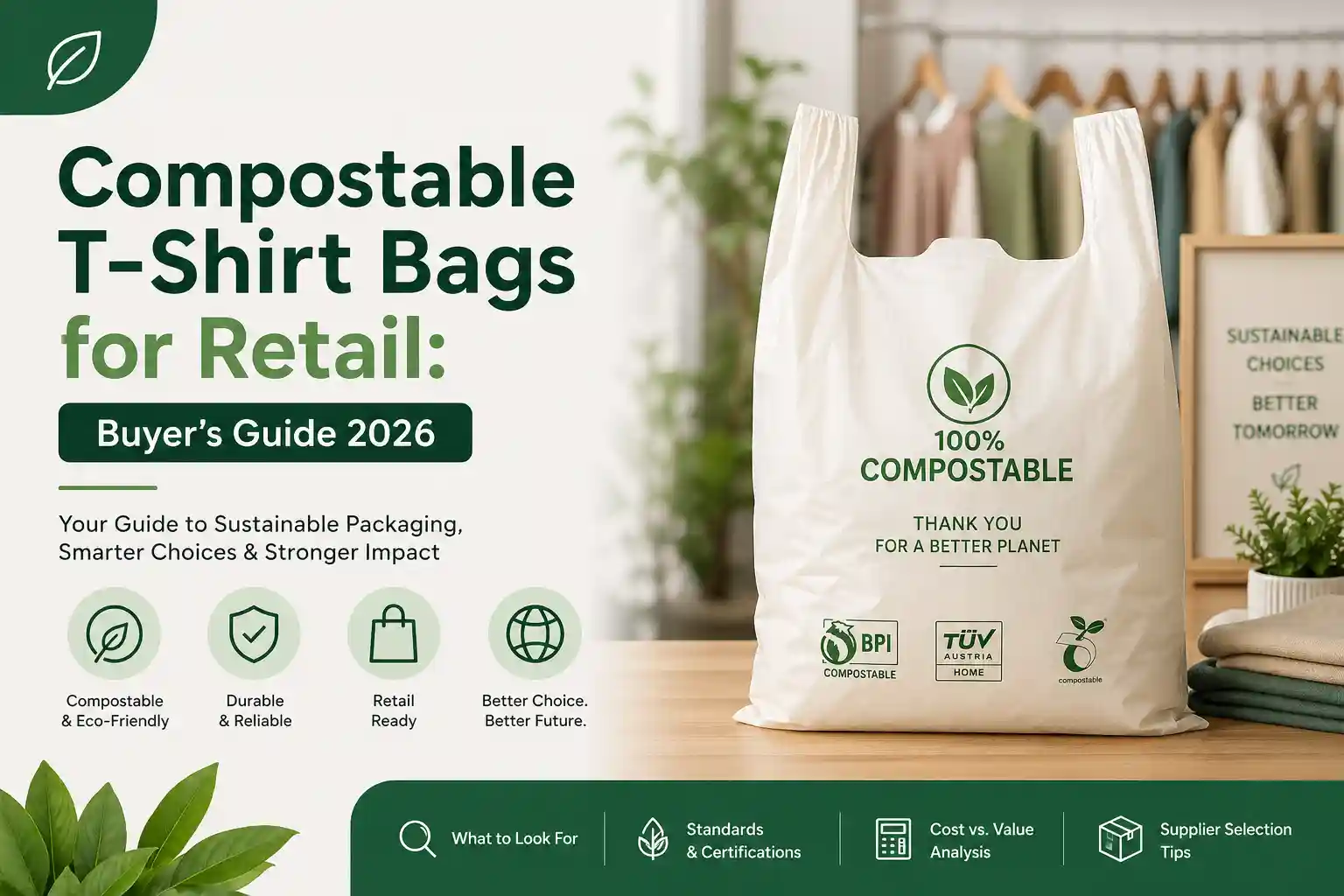
Compostable T-Shirt Bags for Retail: Buyer's Guide 2026
Compostable T-Shirt Bags for Retail: The Compliance and Sourcing Guide for 2026's Plastic Bag Bans
By Janet Liu · April 25, 2026 · Reading time: 7 min
Table of Contents
If your retail chain still uses conventional plastic checkout bags in California, South Australia, or Western Australia, you're already non-compliant. Compostable T-shirt bags for retail are no longer a sustainability aspiration — they are a legal requirement in a growing number of U.S. states and Australian territories. This guide gives retail procurement managers and sustainability officers exactly what they need: a clear breakdown of which laws apply, what the bags must achieve technically, and how to source certified compostable vest carrier bags at commercial volumes without disrupting operations.
1. The Compliance Crisis: Why Retailers Can't Wait Any Longer
2026 marks a regulatory inflection point for retail packaging in the U.S. and Australia. Laws that were proposed, delayed, and phased in are now fully in force — with enforcement teeth attached. In California, while specific penalties for stores that fail to follow the new law are not detailed in SB 1053, related cases have shown penalties from $65,000 to nearly $1 million for manufacturers.
The pattern is consistent across jurisdictions: plastic bag bans start with thin bags, then close loopholes for thicker "reusable" variants, and ultimately create explicit carve-outs that permit only certified compostable alternatives. Retailers who haven't yet switched to certified compostable checkout bags face fines, reputational risk, and supply chain disruption if they scramble last minute.
Transitioning early to alternative products or arrangements and considering all options to reduce the use of single-use and non-compostable and non-biodegradable plastics will be important to retaining and enhancing the sustainability credentials of a business. The time to act is now.
2. California SB 1053 Explained: What Retailers Must Do Now
Governor Gavin Newsom signed Senate Bill 1053, authored by Sen. Catherine Blakespear (D–Encinitas), banning the distribution of plastic bags at grocery stores, pharmacies, and retail checkout counters beginning January 1, 2026.
SB 1053 prohibits stores from offering any plastic bags — regardless of thickness or whether they are labeled reusable. Instead, retailers must provide options such as paper bags made from at least 50% recycled material or certified compostable bags.
The law closes a loophole in the state's 2014 plastic bag law by prohibiting all plastic checkout bags, including thicker versions previously marketed as reusable. This directly eliminates the LDPE "reusable" thick bags that became the dominant checkout bag format after the 2014 ban.
The law applies broadly to grocery stores, convenience stores, pharmacies, and other food retailers across California and will be enforced by local jurisdictions and, in some cases, the state Attorney General, according to guidance from CalRecycle, the state agency overseeing carryout bag compliance.
The enforcement is already active. In October 2025, Attorney General Rob Bonta announced a settlement with four major plastic bag manufacturers after a two-year probe alleging deceptive claims that thicker "reusable" bags were recyclable. The companies agreed to stop selling single-use plastic bags in California and to pay a combined $1.7 million in penalties and fees.
Looking ahead, SB 1053 also establishes a future compliance milestone: beginning January 1, 2028, recycled paper carryout bags must contain at least 50% post-consumer recycled material. Retailers relying on paper bag alternatives should plan for this second transition.
Key Takeaway: Under California SB 1053 (effective January 1, 2026), certified compostable T-shirt bags are one of only two compliant checkout alternatives for covered retailers. Paper bags must be sold at a minimum of $0.10 each. Compostable bags may be distributed without a mandatory fee — giving them a clear customer experience advantage at checkout.
3. Australia's State-by-State Plastic Bag Bans in 2026
Australia's plastic bag regulation is state-level and fast-evolving. Certified compostable bags occupy a legally protected status in several key markets:
South Australia: From 1 September 2024, all plastic shopping bags are banned in South Australia, except those which are certified as compostable. Under the new regulations, a certified compostable plastic bag must be labelled if it is to be considered exempt from the ban as being certified as Australian Standards for home compostable or industrially compostable products.
Western Australia: From 1 October 2025, WA's ban on disposable produce bags extends to include dry goods and confectionery. In 2026, the state will further extend the ban on plastic barrier bags to include bans on non-compostable plastic bags for meat, fish, and dairy. Certified compostable alternatives are allowed for all items, provided they meet Australian Standard AS 4736, European Standard EN 13432, or U.S. standard ASTM D6400.
ACT and Tasmania: Compostable bags certified to Australian Standard AS 4736 and paper bags are permitted in the ACT. In Tasmania, compostable bags certified to Australian Standard AS 4736 are allowed.
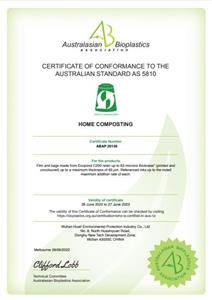
The key standard for Australian compliance is AS 4736 (industrial composting) and AS 5810 (home composting). Retailers sourcing compostable vest carrier bags for the Australian market must confirm that bags carry at least AS 4736 certification — and ideally AS 5810 for broader end-consumer composting flexibility.
4. What Are Compostable T-Shirt Bags and How Are They Made?
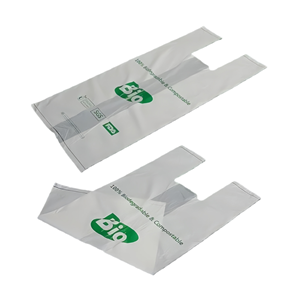
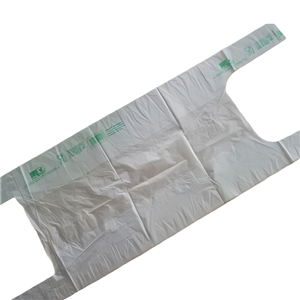
Compostable T-shirt bags — also called vest carrier bags or singlet bags — take their name from the shoulder-strap handle cutouts that resemble a sleeveless top. The T-shirt bag is the most economical way to package items, widely used in supermarkets, grocery stores, vegetable wholesale markets, and other industries.
The compostable version replaces conventional HDPE with a PLA/PBAT/cornstarch blend:
PLA (polylactic acid) — plant-derived, provides rigidity and printability
PBAT (polybutylene adipate terephthalate) — flexible co-polyester delivering tear resistance and elongation
Cornstarch — natural filler that lowers cost and accelerates composting
Biodegradable T-shirt bags on the market are not really a 100% biodegradable material (more or less containing PE ingredients) — only compostable bags are truly plastic-free. This distinction matters for legal compliance: California, South Australia, and Western Australia all require certified compostability, not self-declared biodegradability.
At ECOKEEP (Wuhan Huali), we've manufactured compostable T-shirt bags since 2002 — making us China's most experienced producer of this format. Our R&D team, as a drafter of 15 Chinese national standards for biodegradable materials and a member of the ASTM D20 committee, engineers the PLA/PBAT ratio to deliver the film consistency that retail checkout environments demand across high-volume shifts.
5. Load Strength and In-Store Performance
The number one objection from retail buyers switching from HDPE T-shirt bags: "Will compostable bags hold up at the checkout?" Based on our 24 years of manufacturing experience, the answer is yes — when bags are properly engineered.
Regardless of size, a thickness of 40 microns single layer can meet supermarket shopping and other uses, with a load capacity reaching 5–6 kg. For heavier-duty applications, 50–60 micron variants provide additional carrying strength for grocery loads including canned goods and bottled beverages.
Key performance attributes retailers should specify when sourcing:
Film thickness — minimum 40 microns for standard grocery; 50+ microns for heavy retail
Handle reinforcement — shoulder-strap die-cut handles distribute load more evenly than patch handles
Tear resistance — PBAT content determines elongation at break; specify minimum 300% elongation for checkout environments
Moisture resistance — adequate for ambient grocery use; not designed for wet fish or long-term wet exposure
These bags are strong enough for groceries and take-out without sacrificing eco-friendliness, and are waterproof and tear-resistant — ideal for retail and grocery use, preventing leaks and damage.
Shelf life is equally important for procurement planning. Compostable T-shirt bags maintain a 12-month shelf life in original sealed packaging stored in a cool, dry environment away from UV exposure and humidity — giving category buyers adequate buffer for seasonal inventory cycles.
Key Takeaway: At 40 microns, certified compostable T-shirt bags carry 5–6 kg — comparable to standard HDPE checkout bags. Retailers transitioning from plastic need not compromise on bag performance. Specify film thickness and handle type clearly in your purchase order to ensure consistent performance across stores.
6. Which Certifications Do Compostable Checkout Bags Need?
Certification requirements vary by destination market. Here's a market-by-market breakdown for retail buyers:
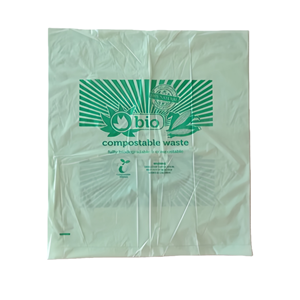
California / United States: ASTM D6400 is the recognized federal standard. BPI certification (Biodegradable Products Institute) is the most widely accepted third-party mark. Washington State additionally requires the certifier logo, the word "compostable," and a color signal (green, beige, or brown) printed on the bag. Many municipalities require ASTM D6400 before accepting bags in organic waste streams.
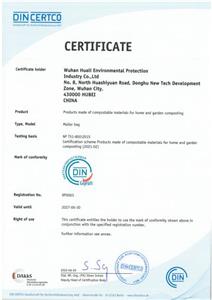
European Union: EN 13432 is mandatory for products marketed as compostable under the Packaging and Packaging Waste Directive. OK Compost INDUSTRIAL (TÜV Austria) and the Seedling logo (DIN CERTCO) are the recognized third-party marks.
Australia: Certified compostable alternatives are allowed for all items, meeting Australian Standard AS 4736, European Standard EN 13432, or U.S. standard ASTM D6400. For home compostability claims, AS 5810 is the applicable standard.
ECOKEEP's compostable T-shirt bags carry EN 13432, ASTM D6400, BPI, OK Compost, and OK Compost HOME (AS 5810) — the full certification stack for compliant retail deployment in California, the EU, and Australia from a single product SKU. Our ISO 9001 and ISO 14001 management systems ensure certificate validity is maintained across all production runs.
7. How to Source Compostable T-Shirt Bags for Retail at Scale
For multi-store retail chains and grocery distributors, compostable checkout bag sourcing involves more variables than a standard HDPE bag reorder. Here's what to evaluate:
Full certification stack — confirm EN 13432, ASTM D6400, and BPI documents are current, not expired. Request copies before ordering
Production capacity — ECOKEEP's annual output exceeds 8,000 metric tons across a 30,000 m² facility, with a standard lead time of 3 weeks for 10-ton orders (FOB Shanghai or FOB Wuhan)
Custom printing — flexible printing with up to 4 colors per side using eco-friendly water-based inks
ensures brand and compliance labeling (certifier logo, color signal, the word "compostable") can all be integrated into the bag artwork
Size range — standard retail sizes are medium (40×31×7 cm) and large (56×35×10 cm); ECOKEEP supports fully custom dimensions for category-specific needs
Vertical integration — suppliers who control resin compounding and film extrusion in-house reduce batch-to-batch inconsistency. As the first manufacturer in China of biodegradable carrier bags, ECOKEEP runs a complete material-to-finished-product chain
Payment and terms — standard terms: 30% T/T in advance, balance before shipment; FOB Shanghai or FOB Wuhan
Interested in a pre-production sample with your store's branding and required certification marks? Contact our team — we provide free printed samples before bulk orders.
FAQ
Are compostable T-shirt bags allowed under California SB 1053?
Stores can still provide recycled paper bags, reusable bags made of approved materials like cloth, or approved compostable bags — just not conventional plastic. Certified compostable bags that meet applicable standards are explicitly permitted under SB 1053 as a compliant checkout alternative.
What's the difference between compostable T-shirt bags and biodegradable T-shirt bags?
All certified compostable bags are biodegradable, but not all "biodegradable" bags are compostable. Many bags labeled "biodegradable" are conventional HDPE with additive accelerants — these do not meet ASTM D6400 or EN 13432 and are not legally compliant under California SB 1053 or Australian plastic bag bans. Only bags with third-party compostability certification (BPI, OK Compost, AS 4736) qualify as compliant plastic bag ban alternatives.
Do I need different bags for the U.S. and Australian markets?
Not necessarily. Bags that hold both ASTM D6400 (U.S.) and EN 13432 (EU/Australia recognized) certifications, plus AS 5810 for Australian home composting compliance, can be deployed across all three markets from a single SKU. ECOKEEP's compostable T-shirt bags carry this full certification stack.
How do compostable T-shirt bags decompose after disposal?
Under industrial composting conditions (55–60°C, sustained moisture, active microbial activity), certified compostable T-shirt bags break down into CO₂, water, and biomass within 180 days — leaving no microplastics or toxic residue. In ambient storage and retail use, the bags perform stably for up to 12 months. They should not be placed in conventional plastic recycling streams.
Need certified compostable T-shirt bags for your retail chain?
ECOKEEP supplies fully certified (EN 13432 + ASTM D6400 + BPI + AS 5810) compostable vest carrier bags to supermarkets, grocery chains, and retail importers across the U.S., Australia, and EU — with custom printing and a 3-week production lead time. Request a free sample today.
Get a Free QuoteReferences
CBS8 — California SB 1053: Banning Single-Use Carryout Bags, January 2026
Juris Law Group — Plastic Checkout Bags Banned in California Beginning 2026
All About Lawyer — California SB 1053 Plastic Bag Ban 2026: Shopper and Retailer Guide
Bag Ban Australia — State-by-State Plastic Bag Ban Information for Australian Retailers
Replace the Waste SA — Guide to the Ban on Plastic Shopping Bags and Food Bag Tags
Australian Retail Council (National Retail Association) — Action on Single-Use Plastics
Australian Marine Conservation Society — Which Australian States Are Banning Single-Use Plastics?