Compostable Produce Bags Supplier: Buyer's Guide 2026
Compostable Produce Bags Supplier: How to Source FDA-Safe, Certified Compostable Fruit and Vegetable Bags for Grocery Retail
By Janet Liu · May 15, 2026 · Reading time: 7 min
Table of Contents
If you're sourcing pre-checkout bags for a U.S. grocery chain, organic food brand, or fresh produce retailer, the compliance landscape shifted materially in January 2025 — and 2026 adds another layer. Compostable produce bags suppliers are now essential partners in your supply chain, not optional vendors. California's SB 1046 mandates that all pre-checkout bags — the roll-type bags used for loose fruit, vegetables, meat, nuts, and bulk goods — must be either certified compostable or recycled paper. Conventional plastic produce bags are gone from California shelves, and more states are expected to follow. This guide gives procurement managers exactly what they need to evaluate, qualify, and onboard the right supplier.
1. California SB 1046: The Law That Changed Produce Bag Sourcing
California's SB 1046 is the foundational compliance driver for any U.S. grocery retailer sourcing produce bags in 2026. SB 1046 prohibits stores from providing a pre-checkout bag that is not a recycled paper bag or compostable plastic bag. The law took effect January 1, 2025, meaning covered retailers are already required to comply.
The new law defines a "pre-checkout bag" as "a bag provided to a customer before the customer reaches the point of sale, that is designed to protect a purchased item from damaging or contaminating other purchased items in a checkout bag, or to contain an unwrapped food item, such as, but not limited to, loose produce, meat or fish, nuts, grains, candy, and bakery goods."
Stores that may only provide customers with compostable or recycled paper pre-checkout bags include: full-line, self-service retail stores with gross annual sales of at least $2 million that sell a line of dry groceries, canned goods, or nonfood items, and some perishable items; large retail stores with a pharmacy that have at least 10,000 square feet of retail space and that generate sales or use tax; and convenience stores, food marts, or liquor stores that are engaged in the retail sale of a limited line of goods, generally including milk, bread, soda, and snack foods, and that hold a Type 20 or Type 21 license.
In California, many of the plastic produce bags used for fresh fruits and vegetables while shopping in stores end up in compost waste streams and thereby contaminate municipal compost facilities. This type of contamination not only increases microplastics in compost, but also leads to increased handling costs which in turn leads to higher rates for consumers. SB 1046 was designed directly to address this problem by replacing conventional plastic with certified compostable alternatives that can safely enter the organic waste stream.
The political durability of the law matters for procurement planning. A challenge, AB 2226, would have repealed SB 1046 outright — but the bill was withdrawn in late April because stakeholders across the system made clear they did not want plastic produce bags back on shelves. AB 2226 being withdrawn signaled that California stakeholders do not want conventional plastic bags back in the produce aisles. Certified compostable produce bags are here to stay.
Key Takeaway: California SB 1046 (effective January 2025) bans conventional plastic pre-checkout bags at all major grocery retailers. Certified compostable produce bags are one of only two compliant alternatives. An attempted repeal was withdrawn in 2026, confirming the law's permanence. Procurement teams should treat this as a long-term sourcing requirement, not a temporary adjustment.
2. What Are Compostable Fruit and Vegetable Bags?
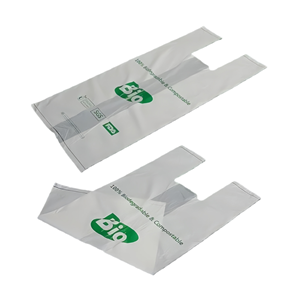
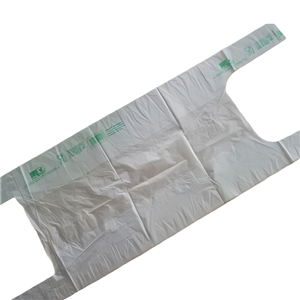
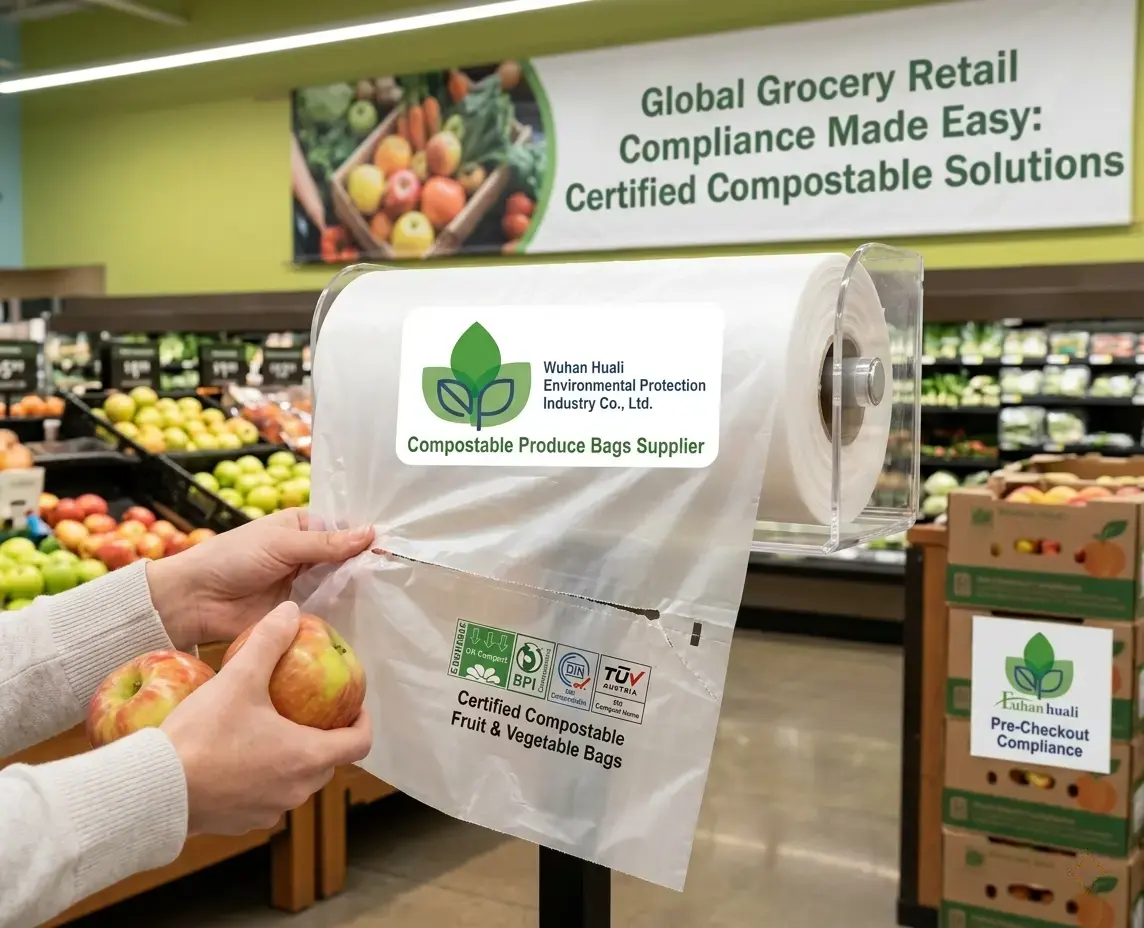
Compostable fruit and vegetable bags — also called pre-checkout bags or grocery produce bag roll bags — are the thin, perforated roll bags mounted on dispensers throughout the produce aisle. The compostable version replaces conventional LDPE or HDPE film with a PLA/PBAT/cornstarch blend:
PLA (polylactic acid) — plant-derived, provides clarity, stiffness, and printability; allows shoppers to see produce through the bag
PBAT (polybutylene adipate terephthalate) — flexible co-polyester that delivers the tear resistance needed for filling bags with heavy or sharp produce items
Cornstarch — a natural filler that reduces raw material cost and accelerates biodegradation under composting conditions
At ECOKEEP (Wuhan Huali), we've engineered this blend for 24+ years. As a drafter of 15 Chinese national standards for biodegradable materials and a member of the ASTM D20 committee, our R&D team optimizes PLA/PBAT ratios to achieve the film clarity that produce buyers expect and the structural integrity that roll-dispenser formats require. The result is a bag that performs in the produce aisle and composts cleanly at the end of its life.
A key design specification that's embedded in California law: the 15-inch opening width SB 1046 specifies wasn't arbitrary — it was designed to let the bag have a second life as a kitchen food scrap caddy liner. Sixty-three percent of respondents in a 2026 California household survey said they reuse compostable produce bags for food scrap collection — confirming that these bags serve dual duty in the state's SB 1383 organics infrastructure.
3. FDA Food-Contact Safety: Why It's Non-Negotiable for Produce Bags
Compostable certification and food-contact safety are two separate compliance requirements — and both are mandatory for produce bags used in U.S. grocery retail. Many buyers focus exclusively on compostability certification and overlook food-contact safety documentation. That's a costly mistake.
Do compostable materials require FDA approval? Yes. All packaging that comes into contact with food must comply with FDA food-contact regulations, regardless of sustainability claims.
Ingredients added directly to food and substances that come into contact with food are generally held to the same safety standard — there must be a reasonable certainty of no harm under the conditions of intended use. For compostable produce bags, this means the PLA/PBAT/starch film, inks, adhesives, and any coatings must all be evaluated for migration safety — not just the base resin.
Food-safe packaging is defined by its inert behavior under intended use conditions. This means the material must not chemically react with food, alter taste or odor, or allow harmful substances to migrate into the food during normal handling, storage, or heating.
Materials commonly used in sustainable packaging, such as PLA can qualify as food-safe, but only after meeting specific FDA standards. These standards evaluate purity, composition, and performance under defined temperature and moisture conditions. Importantly, being natural or plant-based does not automatically make a material food-safe.
The Federal Food, Drug, and Cosmetic Act (FFDCA) is the key piece of legislation covering food contact materials (FCM) in the U.S. It is administered by the Food and Drug Administration (FDA). Regulations pertaining to FCM can principally be found in Title 21 of the Code of Federal Regulations (CFR). For compostable film bags, the relevant sections include 21 CFR 176.170 (components of paper and paperboard in contact with aqueous and fatty foods) and related polymer regulations.
PFAS compliance adds a further layer. Per- and polyfluoroalkyl substances (PFAS) in food contact materials have increasingly been regulated across the U.S. due to their toxic effects and negative impacts on the environment. The use of PFAS in FCM is regulated by several jurisdictions across the U.S. For example, California and New York outlaw PFAS in food packaging made mostly of paper, paperboard, or derived from plant fibers. Any compostable produce bag supplier must confirm their film is PFAS-free.
Key Takeaway: FDA food-contact compliance and compostability certification are independent requirements. A bag can be certified compostable but still fail FDA food-contact standards if its resins, inks, or coatings contain non-approved substances. Always request both the compostability certificate AND an FDA/SGS food-contact migration test report from your supplier.
4. The Certification Stack: What Your Produce Bags Must Carry
For compostable fruit and vegetable bags sold into U.S. grocery retail, the required certification stack is more complex than for checkout bags. Here's what to verify market by market:
California (SB 1046): Products sold in California labeled as "compostable" must have certification that they meet at least one applicable standard specification from an approved third-party certification entity. Any product sold in California must meet ASTM D6400 and D6868 specification standards for commercial composting, or TÜV Austria's OK Compost Home standards for home composting. BPI certification satisfies the ASTM D6400 requirement and is the most widely recognized third-party mark in the U.S. market.
Additional California requirement from January 2026: This requirement applies on and after January 1, 2024. On and after January 1, 2026, the product must also be an allowable agricultural organic input under the requirements of the United States Department of Agriculture. This USDA NOP requirement means compostable bags used in California must now be verified as suitable for agricultural organic inputs — a stricter standard than compostability alone.
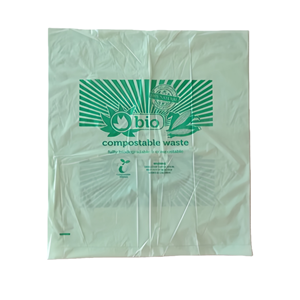
Color and labeling: Compostable plastic bags must be eligible to be labeled with the terms "compostable" or "home compostable" per California law, and must use green, beige, or brown tinting or color schemes.
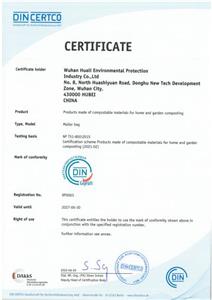
EU markets: EN 13432 certification (TÜV Austria OK Compost INDUSTRIAL or DIN CERTCO Seedling) is required for products marketed as compostable under the Packaging and Packaging Waste Directive.
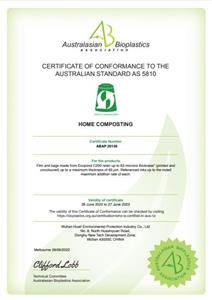
Australia: AS 4736 (industrial composting) is the primary standard. AS 5810 covers home composting. Multiple Australian states explicitly permit compostable bags certified to AS 4736, EN 13432, or ASTM D6400 as alternatives under their plastic bag bans.
ECOKEEP's Compostable Produce Bags carry EN 13432, ASTM D6400, BPI, OK Compost, and OK Compost HOME (AS 5810) — the full certification stack required for compliant deployment across California, the EU, and Australia from a single product SKU. Our bags are produced in green, beige, or natural tones to meet California's color signal requirement.
5. SGS Testing and Third-Party Lab Reports: What Buyers Should Demand
For produce bags in direct contact with food, third-party laboratory testing is the evidentiary foundation of your supplier qualification process. Verified certifications help brands strengthen credibility by providing third-party evidence supporting compostability or food-contact safety claims.
FDA compliance is not the same as compostability certification. A product may be compostable but still require food-contact safety verification. The two documents address different risks and must both be on file before bulk order placement.
Importers should always request FDA, LFGB, or EU 10/2011 food contact reports from suppliers. A credible supplier will provide documents from recognized labs. Ensure reports come from ISO/IEC 17025 accredited laboratories such as SGS or Intertek.
Reports should cover all food types — aqueous, fatty, acidic, and alcoholic — to ensure safety across use cases. For compostable produce bags, the minimum scope should include migration testing for heavy metals, overall migration limits, and specific migration limits for substances regulated under 21 CFR.
At ECOKEEP, we provide an SGS food-contact test report covering migration testing under multiple food simulants as part of our standard supplier documentation package. Brands that clearly communicate food-safety compliance strengthen credibility and reduce the risk of greenwashing claims. Clear documentation, supplier guarantees, and test reports support responsible marketing and informed decision-making across the supply chain. Our test reports are available to qualified buyers before order commitment.
6. SB 1046 On-Bag Labeling Requirements
Compostable produce bags must meet California's specific labeling rules to be legally compliant. Getting the artwork wrong means non-compliance, even if the film itself is certified. Here's what SB 1046 and related California compostability laws require on the bag:
Certification mark — a BPI logo or OK Compost mark from an approved third-party certifier
The word "COMPOSTABLE" — eligible to appear on-bag per California law; no prohibited terms like "biodegradable," "degradable," or "decomposable."
Color signal —
Compostable plastic bags must use green, beige, or brown tinting or color schemes to allow visual differentiation from conventional plastic bags
Minimum 15-inch opening width — mandated by SB 1046 to enable the bag's secondary use as a food scrap caddy liner under SB 1383
No recycling symbol — the chasing arrows symbol must not appear, as it implies recyclability in standard plastic streams
ECOKEEP offers full-surface custom printing with water-based inks. Our in-house artwork team incorporates all mandatory labeling elements — BPI mark, California-compliant color tinting, certification logos, and disposal instructions — into your store-branded bag design before bulk production. Retailers sourcing for multi-state distribution can request a single master artwork that satisfies California, Washington, and EU labeling requirements simultaneously.
7. How to Evaluate a Compostable Produce Bag Supplier
At the decision stage, supplier qualification comes down to documentation depth, production consistency, and supply chain transparency. Importers should review certificate validity dates, issuing organizations, laboratory authenticity, and product scope. Use this structured checklist:
ASTM D6400 + BPI certification — confirm current, in-date BPI letter; BPI certificates are renewed biennially. Verify the certificate explicitly covers the produce bag product (not just a related SKU)
EN 13432 certification — required for EU market access; TÜV Austria or DIN CERTCO issued
SGS or equivalent food-contact migration test report — from an ISO/IEC 17025 accredited laboratory, covering aqueous, fatty, acidic, and alcoholic food simulants; must confirm PFAS-free status
FDA compliance documentation — supplier declaration or test report confirming base resin and inks comply with 21 CFR regulations for food-contact use
USDA NOP agricultural organic input eligibility — required for California SB 1046 compliance from January 2026 onward
ISO 9001 + ISO 14001 management systems — verifiable quality and environmental management certification, auditable by the buyer's own team
Vertical supply chain — suppliers who compound their own resin and extrude their own film reduce batch-to-batch variability. ECOKEEP operates a complete material-to-finished-product chain within a 30,000 m² industrial park at 8,000+ metric ton annual capacity
Roll format compatibility — confirm core size and perforation pitch match your existing in-store dispenser specifications before bulk ordering
Custom printing capability — water-based ink custom printing with color-matched branding and embedded compliance labeling (BPI mark, color signal, compostable claim) in a single production run
Lead time and MOQ — ECOKEEP's standard lead time is 3 weeks for 10-ton orders on FOB Shanghai or FOB Wuhan terms. Payment: 30% T/T in advance, balance before shipment
Shelf life confirmation — ECOKEEP's compostable produce bags maintain a 12-month shelf life in sealed original carton packaging stored dry and away from direct sunlight, giving category buyers adequate seasonal buffer
As China's first manufacturer of biodegradable carrier bags and a drafter of 15 national standards for biodegradable materials, ECOKEEP has supplied certified compostable bags to grocery retailers and organic food brands across the U.S., EU, and Australia since 2002. We understand the technical requirements behind each certification on our documentation stack — because our team helped write the standards. Request our full certification and test report package before placing your first order.
FAQ
What's the difference between a compostable produce bag and a biodegradable produce bag?
AB 1201 prohibits any products sold in California from being labeled "compostable" or "home compostable" unless they meet very strict criteria. Strict labeling standards for compostable products will lessen confusion among consumers and businesses over what products are compostable and how they should be discarded. "Biodegradable" without a third-party certification does not satisfy California SB 1046. Only bags certified to ASTM D6400 (or equivalent) by an approved third-party entity qualify as legally compliant compostable pre-checkout bags.
Do compostable produce bags require FDA approval for food contact?
Yes. All packaging that comes into contact with food must comply with FDA food-contact regulations, regardless of sustainability claims. Compostability certification alone does not satisfy FDA food-contact requirements. Buyers must request a separate SGS or equivalent migration test report from their supplier confirming compliance with 21 CFR regulations and PFAS-free status.
What fines apply if a grocery store provides non-compliant produce bags?
Fines for violations are tiered. For a first offense, businesses may incur a fine of up to $500. A second violation can result in a $1,000 penalty, with subsequent violations reaching $2,000 per occurrence. This structure encourages businesses to rectify compliance lapses swiftly. Cities, counties, and the Office of the Attorney General have the authority to enforce the statutory requirements for pre-checkout bags and recycled paper carryout bags.
Can compostable produce bags be put in California's curbside organics bin?
Most jurisdictions in California do not allow compostable plastic film bags to be placed in organic waste collection bins or carts. Contact your local recycler or curbside program to learn more about the recycling and disposal options in your jurisdiction for managing compostable pre-checkout bags at the end of their useful life. End-of-life disposal guidance should be included in the on-bag artwork to inform consumers appropriately.
Ready to qualify a certified compostable produce bags supplier?
ECOKEEP supplies ASTM D6400 + BPI + EN 13432 certified compostable fruit and vegetable bags with SGS food-contact test reports, California SB 1046 compliant labeling, and 3-week production lead time. Request our full documentation package and a free sample today.
Get a Free QuoteReferences
Californians Against Waste — SB 1046 (Eggman & Gonzalez): Plastic Produce Bags
CalRecycle — Bag Requirements at Grocery and Retail Stores (SB 1046 & SB 1053 Guidance)
Packaging Law — California to Ban Plastic Bags for Produce: SB 1046 Overview
LegalClarity — California SB 1046: Bag Regulations and Compliance Guide
BioCycle — Why California's Next Compostable Packaging Bill Could Stall SB 1383 (May 2026)
Surfrider Foundation California — California Plastic Pollution Reduction Laws Overview
ASTM International — D6400-21 Standard Specification for Compostable Plastics