Compostable Garbage Bags Manufacturer: B2B Buyer's Guide 2026
Compostable Garbage Bags Manufacturer: The B2B Buyer's Guide to Certified, Leak-Proof Waste Bags for Municipal and Commercial Programs
By Janet Liu · May 29, 2026 · Reading time: 7 min
Table of Contents
Why Certification Is the First Filter When Sourcing Compostable Waste Bags
The Municipal Organics Program Boom: What's Driving B2B Demand in 2026
The Real Performance Test: Leak Resistance, Load Strength, and Seal Design
The Certification Stack: BPI, OK Compost, and What Each Market Requires
Composter Acceptance: The Overlooked Variable in Bulk Bag Sourcing
Size Range and Application Guide for Municipal and Commercial Programs
How to Qualify a Compostable Garbage Bags Manufacturer at Commercial Scale
For municipal organics procurement teams, property management companies, and private-label waste bag brands, sourcing compostable garbage bags from the right manufacturer is a higher-stakes decision than it appears. The wrong choice — bags that leak, fail composter acceptance tests, or carry expired certifications — can contaminate an entire organics program, trigger regulatory penalties, and erode community trust in waste diversion infrastructure. This guide gives B2B buyers a structured framework for evaluating compostable trash bags bulk suppliers against the technical, regulatory, and operational standards that municipal and commercial programs actually require in 2026.
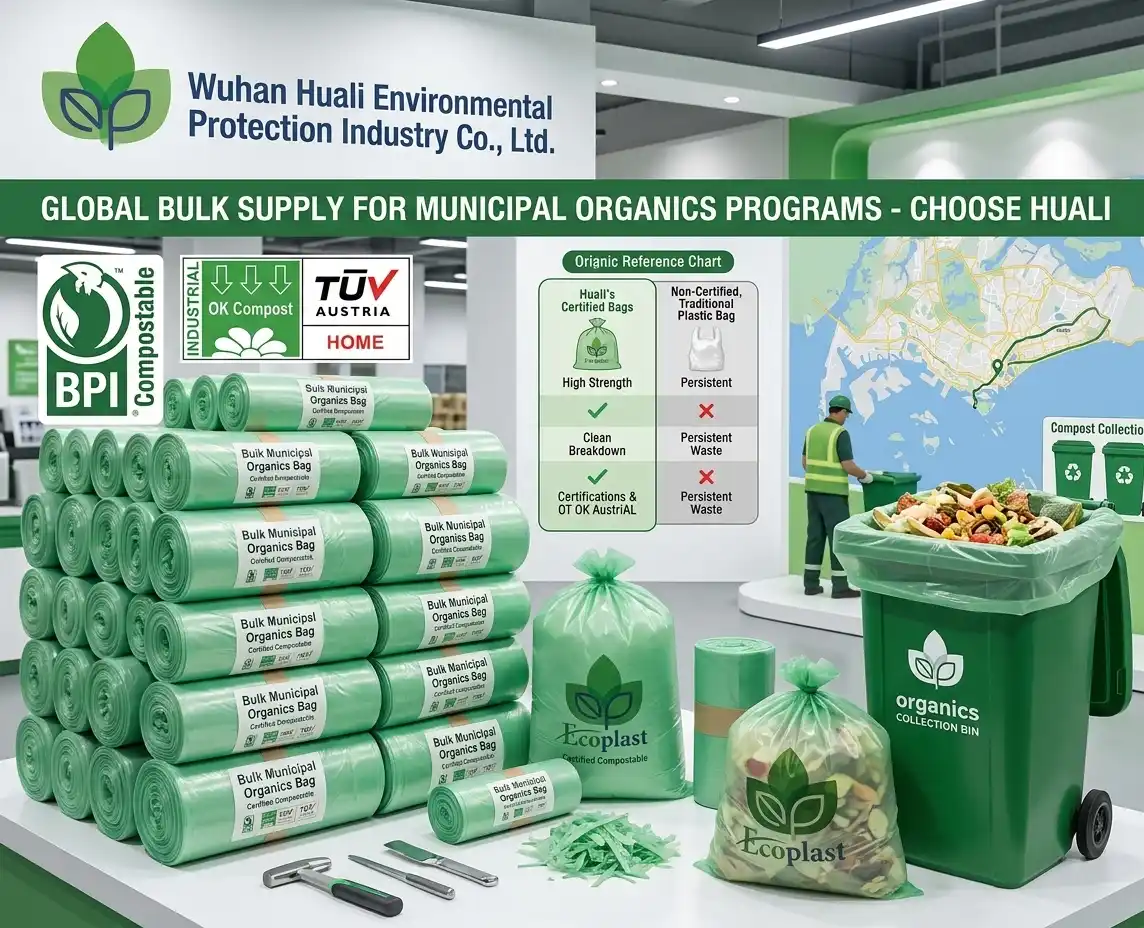
1. Why Certification Is the First Filter When Sourcing Compostable Waste Bags
The compostable waste bag market has a contamination problem — and it starts upstream, not at the composting facility. BPI certification guarantees a product meets strict compostability standards, while "biodegradable" has no consistent definition or timeframe. Yet the market is still flooded with bags carrying "biodegradable" or "eco-friendly" claims backed by nothing more than additive chemistry that fails composting facility intake tests.
The consequences are measurable. More than 40% of municipal solid waste is organic material that could be composted. Yet conventional plastic bin liners contaminate compost streams and take centuries to break down. When uncertified bags — including those with misleading "biodegradable" labels — enter organics streams, composting facilities must screen them out, increasing handling costs and degrading compost quality.
The greatest hurdle is widespread trust and cooperation across the entire supply chain. Reasons for that broken trust stem from a lack of clarity about the fundamental characteristics and benefits of compostable packaging and misinformation about what is truly compostable, with uncertified products creating distrust on both the consumer and composter side.
Certification is not a marketing layer — it's the operational baseline. BPI is the leading authority on compostable products and packaging in North America, thanks to its commercial compostability certification program that has been operating for over 25 years. That program is the most reliable, widely-recognized third-party verification of whether or not an item meets ASTM's compostability standards — a metric required by every U.S. state that has regulatory language around the definition of compostability.
Key Takeaway: Third-party certification — BPI for North America, OK Compost for Europe — is the minimum qualification threshold for compostable waste bags entering municipal organics programs. Procurement teams should disqualify any supplier that cannot provide a current, in-date BPI or TÜV Austria certificate for the specific product SKU being ordered.
2. The Municipal Organics Program Boom: What's Driving B2B Demand in 2026
Demand for certified compostable bin liners wholesale is being driven by an accelerating wave of mandatory organics diversion programs across the U.S., EU, and Australia. The regulatory push is structural and multi-jurisdictional — not a single law, but a cascading series of mandates at state, county, and city levels.
In California, as a result of SB 1383, the City is required to provide three-container solid waste service — garbage, recycling, and organics — to all residents and businesses. This three-bin mandate, rolling out across thousands of California jurisdictions, creates direct procurement demand for certified compostable bag liners that are accepted at receiving composting facilities.
Washington State is tightening organics diversion requirements alongside its plastic bag regulations. In 2026, the waste threshold decreases to include any business that produces over 96 gallons of organic waste per week. Seattle County requires all single-family and multifamily residences and commercial businesses to separate food waste and subscribe to compost collection services.
Minnesota is advancing its own certification infrastructure. A compostable labeling law went into effect in January 2025, expanding an existing law for compostable bags for yard debris to include packaging and food service ware. The label bill is intended to reduce confusion around what is compostable, remove terms like "biodegradable" that don't have standards to be measured against, and ultimately prevent misleading claims and decrease contamination upstream. Beginning in 2026, a certification requirement will back up the ASTM standards.
At the county level, programs are proliferating. Beltrami County's organics program has been upgraded, with six regional counties introducing specially designed bags to hold organic materials, which will be separated and turned into compost. Each new program creates a direct procurement tender for certified compostable waste bags at institutional volumes.
3. The Real Performance Test: Leak Resistance, Load Strength, and Seal Design
The number one operational concern from municipal program managers and property management buyers: will the bags hold wet food waste without leaking during collection? It's a legitimate concern — and the answer depends entirely on film engineering and seal design, not just material certification.
Made from renewable, plant-based biopolymers, certified compostable bags are 100% plastic-free and contain no polyethylene. With durable tear-resistance and leak-proof strength, they handle everything from fruit and vegetable scraps to heavy leftovers without the mess.
At ECOKEEP (Wuhan Huali), our compostable garbage bags are engineered with a PLA/PBAT/cornstarch blend optimized for wet waste containment. The critical specifications are:
Film thickness — minimum 15 microns for standard kitchen caddy liners; 20–25 microns for heavy-duty organics and general garbage applications; 30+ microns for commercial and yard waste programs
Seal type — star seal (bottom seal with no vertical side seams) is the industry standard for leak resistance in garbage bag formats. Our star-sealed designs eliminate the corner weakness points present in side-seal construction
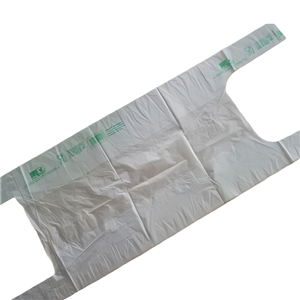
Closure options — flat open top (standard roll bag), drawstring (premium residential and commercial), and tie-handle (institutional) formats available; drawstring designs provide the highest resistance to spillage during lift-and-carry operations
PBAT content ratio — higher PBAT content increases elongation-at-break, the critical measure of puncture resistance when bags contact sharp food waste like bones, shells, or citrus rinds
As China's first manufacturer of biodegradable courier and carrier bags — operating since 2002 — our R&D team has refined the PLA/PBAT blend for 24 years across high-volume production runs. In our experience, manufacturing over 8,000 metric tons annually, the most common cause of bag failure in the field is undersized film thickness relative to waste density, not material composition. We specify minimum thicknesses based on the application during the sample approval stage.
Key Takeaway: Star-sealed compostable garbage bags with ≥20 micron film thickness provide the leak resistance required for wet food waste applications in municipal curbside and commercial kitchen programs. Always specify seal type, film thickness, and closure format — not just bag dimensions — when issuing a purchase order to your manufacturer.
4. The Certification Stack: BPI, OK Compost, and What Each Market Requires
For compostable waste bags entering B2B supply chains across North America, Europe, and Australia, the required certification stack differs by destination. Here's the market-by-market breakdown:
North America (USA and Canada): All products certified by BPI meet ASTM standards for compostability, are subject to eligibility criteria around the connection to food scraps and yard trimmings, meet limits for total fluorine (PFAS), and must display the BPI Certification Mark. BPI certification based on ASTM D6400 is the recognized standard. BPI's standard for fluorinated chemicals (PFAS) went into effect on January 1, 2020. Products may no longer be claimed as BPI-certified unless they meet all conditions of the rule, including no intentionally-added fluorinated chemicals, a test report showing less than 100 ppm total organic fluorine, and a technical review of the formulation.
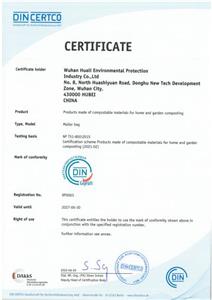
European Union: EN 13432 certification is mandatory for products marketed as compostable under the Packaging and Packaging Waste Directive. TÜV Certified Compostable products are independently tested to meet Europe's EN 13432 compostability standard. The OK Compost INDUSTRIAL mark (TÜV Austria) is the most widely recognized third-party label across EU markets. The Seedling logo (DIN CERTCO / European Bioplastics) is also widely accepted, and proves a product is certified industrially compostable according to EN 13432 — a 3rd party certification by TÜV AUSTRIA authorized by European Bioplastics, usually certified in addition to OK Compost Industrial to ensure compostable certification throughout the European market.
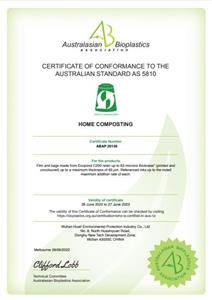
Australia: AS 4736 governs industrial compostability; AS 5810 governs home compostability. Multiple Australian states explicitly accept compostable bags certified to either AS 4736, EN 13432, or ASTM D6400 as compliant alternatives under their plastic bag and organics waste legislation.
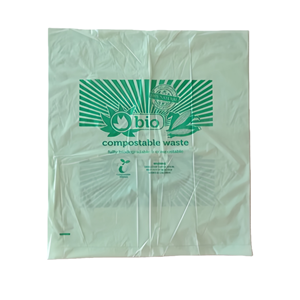
Minnesota and expanded U.S. state requirements: Certified compostable products must display a certification logo indicating compliance with the ASTM D6400 standard, verified by a third-party independent body (BPI and CMA). They must have a uniform color — green, beige, or brown — and be labeled "compostable" on one or both sides of the bag, meeting industry standards for quick identification in public sorting areas and processing facilities.
ECOKEEP's Compostable Garbage Bags and Compostable Trash Bags carry the full certification stack: EN 13432, ASTM D6400, BPI, OK Compost INDUSTRIAL, and OK Compost HOME (AS 5810). Our ISO 9001, ISO 14001, and ISO 45001 management systems ensure certificate validity is maintained across all production batches at our 30,000 m² Wuhan facility.
5. Composter Acceptance: The Overlooked Variable in Bulk Bag Sourcing
Municipal buyers often focus exclusively on product certification and overlook a parallel requirement: whether the specific certified bag is accepted by the composting facilities serving their jurisdiction. These are not always the same thing.
Do all composting facilities accept BPI-certified products? Most commercial composting facilities accept BPI-certified products, but acceptance can vary by location. Always check with your local facility before disposal.
Some jurisdictions go further. While well-intentioned, eco-friendly plastic bags do not break down fast enough for a large-scale composting operation. They take much longer than the normal compost cycle of six weeks. Facilities with accelerated processing cycles — particularly in-vessel and tunnel composting operations — may require bags that disintegrate faster than the 12-week EN 13432 or ASTM D6400 threshold.
The Compost Manufacturing Alliance (CMA) goes beyond the lab — combining ASTM testing with field trials at commercial compost facilities. Composters value this approach precisely because it tests bags under real operating conditions, not just controlled laboratory environments. For municipal procurement teams, CMA certification provides an additional layer of confidence beyond BPI alone.
Best practice for institutional buyers: before issuing a bulk tender, contact the composting facility or facilities that will receive the organics stream and confirm their accepted bag list. Provide your shortlisted supplier's BPI and EN 13432 certificate numbers for direct verification. ECOKEEP can provide a full documentation package — including certificate numbers and lab report identifiers — for facility pre-approval before bulk order placement.
6. Size Range and Application Guide for Municipal and Commercial Programs
Compostable garbage bags for B2B programs span a wide range of sizes and formats. Matching the right specification to the application prevents the most common field failures — bags too small for actual waste volumes, or film too thin for heavy commercial loads.
2–4 gallon countertop caddy liners — for residential kitchen collection pails under three-bin curbside programs; star seal, green tinted, minimum 12–15 microns
8–13-gallon kitchen bin liners — standard residential under-sink bin size; star seal or drawstring; 15–20 microns; the most common size in municipal residential programs
23–33 gallon tall kitchen/office bin liners — commercial kitchen, restaurant, and institutional food service; drawstring or flat open top; 20–25 microns
39–55 gallon heavy-duty liners — commercial organic waste collection, yard waste, and large-volume institutional programs; star seal or side gusset; 25–35 microns
These compost bags come in a variety of sizes for different applications, from countertop to commercial kitchens and farms, and are great for both home and business use. ECOKEEP supports fully custom dimensions and thickness specifications — including paper core roll formats for institutional dispensing systems — across all size categories.
7. How to Qualify a Compostable Garbage Bags Manufacturer at Commercial Scale
At the decision stage, supplier qualification for certified compostable waste bags requires documentation depth, production capacity verification, and physical sample approval. Use this structured checklist:
BPI certification — current and product-specific — BPI certificates are renewed biennially. Confirm the certificate explicitly covers the garbage bag/bin liner SKU being ordered, not just a related product line. Cross-reference with the BPI online product catalog, which lists all certified items by company and item number
OK Compost INDUSTRIAL certificate (TÜV Austria) — required for EU market access; confirm the certificate number and expiry date directly with TÜV Austria's online verification portal
PFAS-free confirmation — request a lab test report showing less than 100 ppm total organic fluorine, as required by BPI's 2020 rule and increasingly by municipal program specifications
Physical leak test samples — always request pre-production wet-fill samples before bulk order approval. Fill the bag with water to the intended fill weight, seal, and hold for 60 minutes. This is the single most reliable field test for seal integrity
Star seal construction confirmation — for wet waste applications, star seal is the mandatory construction type. Side-sealed garbage bags have inherent corner leak vulnerability under wet load conditions
CMA (Compost Manufacturing Alliance) certification — increasingly requested by U.S. composting facilities as a supplement to BPI; provides real-facility disintegration validation beyond laboratory testing
ISO 9001 + ISO 14001 + ISO 45001 — quality, environmental, and occupational safety management systems; auditable by institutional buyers' own quality teams
Annual production capacity and lead time — ECOKEEP produces 8,000+ metric tons annually at a 30,000 m² industrial park in Wuhan, with a standard production lead time of 3 weeks for 10-ton orders on FOB Shanghai or FOB Wuhan terms; payment 30% T/T in advance, balance before shipment
Custom color and labeling — municipal programs typically require green, beige, or brown bags with on-bag compostable labeling, certifier logos, and disposal instructions; ECOKEEP supports full-surface custom printing with water-based inks in up to 4 colors per side
Shelf life documentation — ECOKEEP's compostable garbage bags maintain a 12-month shelf life in sealed original carton packaging stored dry and away from direct sunlight; essential for municipal stockpiling and seasonal demand management
As a drafter of 15 Chinese national and industrial standards for biodegradable materials and China's first manufacturer of biodegradable courier bags, ECOKEEP has supplied certified compostable waste bags to municipalities, property managers, and private-label brands across the U.S., EU, and Australia since 2002. Our documentation package — including all certificates, PFAS test reports, SGS test reports, and ISO certificates — is available to qualified buyers before order commitment. Request your full documentation package and free samples today.
FAQ
What's the difference between compostable garbage bags and biodegradable garbage bags?
BPI Certified items guarantee compliance with recognized scientific standards and third-party verification. Generic "biodegradable" claims alone can be ambiguous or misleading; they may not guarantee breakdown under composting conditions, could take much longer, or leave unwanted residues. BPI certification gives consumers, businesses, and composters confidence that the products are truly compostable and environmentally safe. For municipal programs, only certified compostable bags — not self-declared biodegradable bags — are accepted.
Do all municipal composting facilities accept BPI certified compostable bags?
Most commercial composting facilities accept BPI-certified products, but acceptance can vary by location. Always check with your local facility before disposal. For municipal procurement teams, pre-approval of the specific bag SKU with the receiving composting facility is best practice before issuing a bulk tender. ECOKEEP provides certificate numbers for direct facility verification.
What seal type is best for wet food waste in compostable garbage bags?
Star seal construction — where the bottom of the bag is sealed in a star pattern with no vertical side seams — is the industry standard for compostable garbage bags used in wet food waste applications. BPI Certified compostable can liners are perfect for collecting kitchen scraps and other compostables. Size up your container and securely tie off each bag before removing it from the can to prevent leakage under load. ECOKEEP's standard garbage bag format uses star seal construction across all size variants.
Can compostable garbage bags be used for general household trash, not just organics?
Yes — certified compostable garbage bags and trash bags function identically to conventional polyethylene bags for general household waste collection. However, their environmental benefit is only realized when the filled bag enters an industrial composting stream. Because BPI certification is based on industrial composting standards, these items should be sent to commercial composting facilities or municipal compost programs that manage organic waste. Home-compost setups often don't maintain the consistent high-heat, moisture, and microbial activity required for full decomposition. For brand owners marketing to residential consumers, bags carrying the OK Compost HOME or AS 5810 certification extend composting eligibility to backyard composting programs.
Ready to source certified compostable garbage bags at scale?
ECOKEEP supplies BPI + OK Compost certified compostable trash bags and bin liners in bulk — with star-seal construction, PFAS-free confirmation, custom printing, 8,000+ MT annual capacity, and a 3-week production lead time. Request free samples and our full certification package today.
Get a Free QuoteReferences
Biodegradable Products Institute (BPI) — Commercial Compostability Certification Program
BPI — Online Certified Products Catalog (50,000+ certified items)
Waste360 — Minnesota Introduces New Compost Laws and Programs, November 2025
Vanguard Renewables — U.S. Organic Waste Bans and Mandates by State, 2026
City of Brentwood, CA — Mandatory Organics Requirements (SB 1383 Implementation)
Keller and Heckman — California Tightens Requirements for Labeling Products as Compostable (AB 1201)
Washington State Dept. of Ecology — Compostable Product Labeling Requirements
Good Start Packaging — Standards and Certifications for Compostable Products
ASTM International — D6400-21 Standard Specification for Compostable Plastics