Compostable Dog Poop Bags Wholesale: B2B Buyer's Guide 2026
Compostable Dog Poop Bags Wholesale: The B2B Buyer's Guide to Certified Eco-Friendly Pet Waste Bags That Build Brand Trust
By Janet Liu · June 15, 2026 · Reading time: 7 min
Table of Contents
The Greenwashing Problem in Pet Waste Bags — and Why It's Getting Worse
The Market Opportunity: Why Certified Compostable Poop Bags Win in 2026
Biodegradable vs. Compostable Dog Waste Bags: A Critical Legal Distinction
AS 5810 Home Compostable Certification: The Standard That Sets Premium Brands Apart
Leak Resistance, Thickness, and Closure Design for Dog Waste Applications
OEM and Private Label: Launching Your Own Certified Compostable Poop Bag Brand
How to Evaluate a Compostable Dog Poop Bags Wholesale Supplier
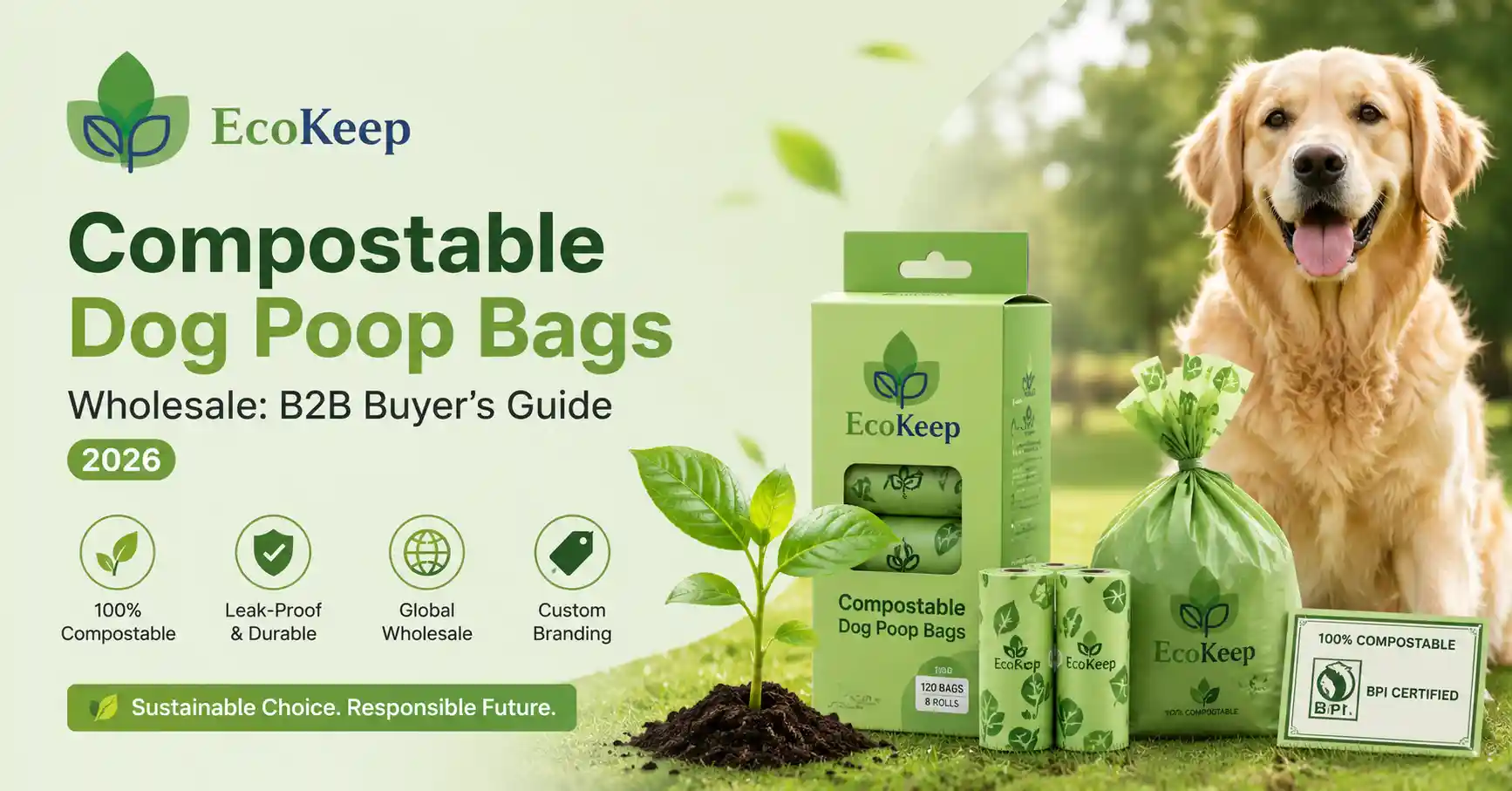
If you're building a pet brand on Amazon, distributing through specialty pet retail, or launching a private-label line of eco-friendly dog waste bags, the sourcing decision you make on certification will define your brand's compliance position and consumer trust ceiling. The compostable dog poop bags wholesale market is flooded with suppliers making "biodegradable" and "eco-friendly" claims that have no third-party verification behind them. The FTC has already sent warning letters to 20 poop bag manufacturers over deceptive environmental claims. In 2026, the cost of getting this wrong — in regulatory fines, marketplace delisting, and consumer trust — is higher than ever. This guide gives pet brand owners and distributors a structured framework for sourcing genuinely certified compostable dog waste bags at commercial volumes.
1. The Greenwashing Problem in Pet Waste Bags — and Why It's Getting Worse
The pet waste bag category has one of the highest concentrations of unverified green claims in consumer packaged goods. According to one investigation, 40% of "green" claims made on websites may be misleading. Companies are tapping into genuine and growing enthusiasm for environmentally sustainable products by marketing their products as "recyclable," "biodegradable," or "compostable" — and some are taking advantage of consumer preference for sustainable products without backing those claims with science.
The FTC took direct action on this category. In 2015, the FTC sent warning letters to 20 poop bag manufacturers and marketers over biodegradable and compostable claims. The FTC's warning was specific: sellers of pet waste bags described as "biodegradable" and "compostable" fail to conform to the Green Guides and are likely deceptive, in violation of the FTC Act.
The core problem is structural. The word "biodegradable" has no standardized legal definition in the United States. Any manufacturer can print it on any product without meeting a specific standard, passing a specific test, or providing any third-party verification. That is not a regulatory gap being closed — it is the current state of the market in 2026. The FTC Green Guides (16 CFR Part 260, Section 260.8) impose one constraint: an unqualified biodegradable claim may be considered misleading under FTC guidelines if the product does not completely decompose within one year after customary disposal.
For dog waste bags, "customary disposal" means household bins, then municipal solid waste, then standard landfill — and landfills do not support complete decomposition within one year for any currently available bag material. Brands using "biodegradable" on standard poop bags without ASTM D6400 certification face ongoing legal exposure.
Key Takeaway: "Biodegradable" on a dog poop bag is not a compliance claim — it's a marketing statement with no standard definition and active FTC enforcement risk. Only ASTM D6400, EN 13432, or AS 5810 certified bags meet the legal threshold for compostable claims in the U.S., EU, and Australian markets.
2. The Market Opportunity: Why Certified Compostable Poop Bags Win in 2026
The commercial tailwinds behind certified eco-friendly dog waste bags are substantial. The global pet poop bags market was valued at USD 842 million in 2025 and is expected to reach USD 1,450 million by 2032, growing at a CAGR of 8.2% from 2026 to 2032. The certified compostable premium segment is growing even faster — at an estimated 8–12% per year, increasing its share of retail value from roughly 30–35% in 2026 toward 45–55% by 2035.
The U.S. market alone consumed between 30 billion and 40 billion individual bags in 2025. Online channels — Amazon, Chewy, DTC — now represent 30–40% of pet owner bag purchases, up from 15–20% in 2020. Recurring subscription models are driving repeat purchase economics that favor certified brands over commodity suppliers.
The competitive dynamics are shifting toward certification. The FTC Green Guides and state-level plastic laws are forcing manufacturers to validate biodegradable and compostable claims with ASTM D6400 or equivalent certifications — raising barriers for low-cost importers and accelerating consolidation around certified products. The category is heavily influenced by pet population demographics — peak dog ownership among households aged 25–44 — and strong branding dynamics where national players, private-label retailers, and niche eco-brands compete on dispenser design, leak-proof performance, and environmental storytelling. Certification is now a central pillar of that story.
3. Biodegradable vs. Compostable Dog Waste Bags: A Critical Legal Distinction
The distinction between "biodegradable" and "compostable" is not semantic — it's the difference between a substantiated claim and a deceptive one under current U.S., EU, and Australian law.
Biodegradable is an unregulated term with no standard U.S. definition or required testing. Any brand can use it. Compostable, when certified to ASTM D6400, specifies that the product will fully biodegrade in an industrial composting environment within 180 days, leaving no toxic residue. All compostable products are biodegradable under the right conditions, but not all biodegradable products are compostable.
The practical implications for B2B buyers are significant:
Oxo-degradable bags — conventional plastic with additive accelerants that fragment under UV or heat exposure. These are banned in the EU under the Single-Use Plastics Directive and explicitly prohibited from being labeled "compostable." They fail EN 13432 and ASTM D6400. Avoid completely
"Biodegradable" without certification — no test standard, no timeframe, no third-party verification. FTC enforcement risk. Not accepted by Australian FOGO programs. Not compliant in California, Washington, or Minnesota
ASTM D6400 certified compostable — laboratory-verified, 90% biodegradation within 180 days in industrial composting; recognized by U.S. regulators, BPI certification available
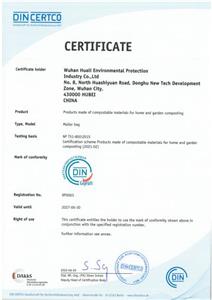
EN 13432 certified compostable — EU mandatory standard; TÜV Austria OK Compost or DIN CERTCO Seedling mark; legally required for "compostable" label claims in the EU
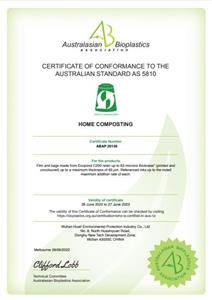
AS 5810 home compostable — Australia's strictest standard; decomposition without industrial heat required; the highest-value certification for consumer-facing pet waste bag brands globally
4. The Certification Stack: What Each Market Requires
For pet waste bag brands distributing across multiple markets, the required certification stack differs by geography. A compostable poop bag that carries BPI (USA), EN 13432 (EU), or AS 5810 (Australia) certification proves genuine environmental credentials.
United States: BPI certification ensures that a product meets the ASTM D6400 standard and is suitable for industrial composting facilities. A critical nuance for U.S. sellers: BPI has historically declined to certify dog waste bags for U.S.-based companies because pet waste is not accepted at the majority of U.S. composting sites. However, products certified by manufacturers outside the U.S. and meeting ASTM D6400 can still carry that standard's certification mark. For this reason, OK Compost HOME — which covers home-environment decomposition and does not require composting facility acceptance — is often the stronger marketing claim for the U.S. pet waste market. California recognizes OK Compost HOME as a compliant compostable claim for bags sold in the state.
European Union: In Europe, TÜV Austria is a prominent certification body for compostable products. Their "OK Compost" certification guarantees that a product meets the EN 13432 standard and is suitable for industrial composting facilities. EU pet waste bag brands should hold EN 13432 as a baseline, with OK Compost HOME providing broader end-consumer disposal flexibility.
Australia: Only AS 4736 and AS 5810 certified bags meet Australia's strict standards — not generic "biodegradable" claims. Biodegradable or degradable plastic bags are usually not accepted in Australian FOGO programs. Councils and waste contractors typically require AS 4736 or AS 5810 certified compostable bags. The Australasian Bioplastics Association (ABA) is the leading certification body for compostable products in Australia and New Zealand — their certification ensures products meet the AS 4736 standard.
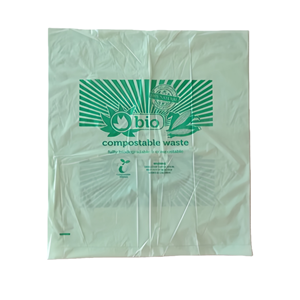
ECOKEEP's Compostable Dog Poop Bags carry EN 13432, ASTM D6400, BPI, OK Compost INDUSTRIAL, and OK Compost HOME (AS 5810) — the full global certification stack for brands distributing across the U.S., EU, and Australia from a single SKU.
5. AS 5810 Home Compostable Certification: The Standard That Sets Premium Brands Apart
For pet waste bag brands targeting premium positioning on Amazon and in specialty retail, AS 5810 home compostable certification is the single most powerful trust signal available in 2026.
AS 5810 is Australia's home compostable standard. It evaluates whether a finished product can decompose safely in low-temperature, unmanaged household composting environments. Home composting environments are far less controlled than industrial composting facilities — temperatures are lower, moisture varies, and microbial activity is inconsistent. AS 5810 was designed to reflect these real conditions. A product that passes AS 5810 must break down without relying on industrial heat, machinery, or active management. This makes AS 5810 one of the strictest compostability standards globally.
Due to the extreme and stringent requirements of the AS 5810-2010 standards, it holds true that whichever product meets the home compostable standard, it will meet the industrial standard. The Australian Standards include extra requirements — such as a worm toxicity test — and the ABA verification program also checks for non-intentionally added PFAS and other harmful substances.
For pet brand owners, AS 5810 solves a key consumer objection: most consumers disposing of dog waste bags don't have access to industrial composting facilities. A bag that certifiably breaks down in a home compost bin — or at minimum, decomposes without leaving microplastics — is a meaningfully superior environmental claim to industrial-only composting. This distinction resonates with the environmentally conscious millennial and Gen Z pet owners who drive premium pet care spending.
Key Takeaway: AS 5810 home compostable certification is the strictest compostability standard globally. For pet waste bag brands, it resolves the key consumer concern about industrial facility dependency — and differentiates certified products from the mass of unverified "biodegradable" competitors on Amazon and in specialty retail.
6. Leak Resistance, Thickness, and Closure Design for Dog Waste Applications
Certification answers the "is it compostable?" question. But the "does it work?" question is equally important for brand reputation — and harder to answer from a certificate alone. Compostable dog poop bags must perform reliably in real-world field conditions: being pulled from a dispenser one-handed, wrapped around fresh waste, knotted under time pressure, and carried for the remainder of a walk.
High-quality compostable dog waste bags are typically made from PLA (polylactic acid), PBAT, and cornstarch blends. These materials are certified to disintegrate and biodegrade under composting conditions. Thanks to new materials like PLA and cornstarch, biodegradable bags now match the strength and thickness of regular plastic bags — you can find extra-thick, leak-proof bags that work for dogs of all sizes.
Avoid oxo-degradable or "biodegradable" without certification — they often fragment into microplastics, which is the opposite of an environmental benefit.
At ECOKEEP, our compostable dog waste bags are engineered to the following specifications based on 24 years of biopolymer film manufacturing:
Film thickness — 15 microns standard; 18–22 microns for extra-thick variants suited to large breeds. Always ask for tensile strength data and leak-proof test results (ASTM D1709) from any supplier
Closure design — flat top (standard roll), easy-tie handles, and drawstring options. Drawstring designs provide the highest resistance to spillage during carry and typically command a 10–15% retail price premium
Roll format — perforated roll bags on cardboard cores for dispenser compatibility, or refill rolls for subscription packaging formats
Scent options — lavender and unscented variants; ensure any fragrance additives do not compromise compostability certification (must be retested if added post-certification)
Color — standard green tinting (required by most Australian jurisdictions and recommended by California and Minnesota compostable labeling guidelines)
Always order pre-production samples (printed bags and dispenser if applicable) before mass production — this allows you to verify thickness, seal strength, and print alignment, especially important for drawstring functionality.
7. OEM and Private Label: Launching Your Own Certified Compostable Poop Bag Brand
For Amazon sellers and pet specialty distributors, private-label compostable dog waste bags represent the most direct path to margin expansion in the eco-pet category. Rather than competing on price with commodity biodegradable bag sellers, private-label brands compete on certification credibility, packaging design, and subscription economics.
The market is favorable for this strategy. The category exhibits strong branding dynamics, with national pet-care players, private-label retailers, and niche eco-brands competing on dispenser design, leak-proof performance, and environmental storytelling. Brands should refine subscription models with tiered packaging options to cater to diverse household sizes.
A successful OEM compostable dog poop bag launch requires:
Brand-specific certification documentation — the OEM manufacturer must be the certificate holder, and your private-label product must be listed on their BPI or TÜV Austria certificate. Verify this explicitly — a manufacturer's certificate does not automatically cover all products they produce under your brand name
Retail packaging design — dispenser boxes, counter display units, and subscription refill pouches all require separate artwork. Water-based ink printing on compostable bags and recycled card packaging maintains the full sustainability story across the product experience
Amazon compliance readiness — Amazon's Climate Pledge Friendly program requires third-party certification for compostable claims. BPI and TÜV Austria certifications are among the recognized marks. Listing without verification exposes sellers to customer complaints and potential delisting
Subscription packaging format — rolls in compostable or recycled kraft pouches with tear-open dispensing are the dominant format in subscription pet boxes; specify roll count per pouch and perforation pitch for your dispenser design
At ECOKEEP, we've provided OEM and private-label compostable dog waste bags to pet brands in the U.S., EU, UK, and Australia since 2002. Our water-based flexo printing supports Pantone color matching, custom logo placement, and the integration of all mandatory certification marks — BPI logo, OK Compost HOME mark, color-coded green tinting, and disposal instructions — in a single production run. As a drafter of 15 national biodegradable materials standards and ASTM D20 committee member, our R&D team can advise on any market-specific labeling requirements before artwork is finalized. Request a free OEM sample and certification package.
8. How to Evaluate a Compostable Dog Poop Bags Wholesale Supplier
At the consideration stage, supplier qualification for certified compostable dog waste bags comes down to documentation integrity, physical sample performance, and OEM service depth. Use this structured checklist:
EN 13432 + OK Compost HOME (AS 5810) — for global brand distribution, these two certifications cover the EU, Australia, and consumer-facing home composting claims in the U.S. Request current certificate copies and verify certificate numbers with TÜV Austria's online database
ASTM D6400 / BPI documentation — confirm the specific dog waste bag SKU is listed on the BPI certificate; per the BPI eligibility policy, confirm whether BPI directly certifies the bag for U.S. use or whether the claim is based on international certification
PFAS-free confirmation — the ABA verification program checks for non-intentionally added PFAS; request a test report showing total organic fluorine below 100 ppm for U.S. BPI compliance and Australian ABA compliance
Physical leak test samples — fill a bag with 400–500g of wet material, knot, and hold inverted for 5 minutes. This is the most reliable field test for seal integrity and film thickness adequacy
ASTM D1709 tensile strength data — request formal tensile strength and elongation-at-break data for the specific film thickness you're ordering; don't rely on thickness alone as a strength proxy
OEM artwork capability — confirm water-based inks, Pantone color matching, all certification logos integrated, and compliance labeling (color signal, "compostable" claim) in the supplier's standard printing workflow
Roll format specifications — confirm core diameter, perforation pitch, and bags-per-roll count for compatibility with your dispenser or subscription packaging format
ISO 9001 + ISO 14001 + ISO 45001 — quality, environmental, and occupational safety management systems; auditable by brand owner's quality team
Production capacity and lead time — ECOKEEP produces 8,000+ metric tons annually with a standard lead time of 3 weeks for 10-ton orders on FOB Shanghai or FOB Wuhan terms; payment 30% T/T in advance, balance before shipment
Shelf life documentation — ECOKEEP's compostable dog poop bags maintain 12-month shelf life in sealed original carton packaging stored dry and away from direct sunlight; essential for subscription brands managing 3–6 month forward inventory positions
FAQ
Why can't I just use "biodegradable" dog poop bags for my brand?
Biodegradable is an unregulated term with no standard U.S. definition or required testing. Any brand can use it. The FTC has sent warning letters to 20 poop bag manufacturers over biodegradable claims. Brands using unqualified biodegradable language on landfill-bound bags remain at legal risk under FTC enforcement. In 2026, states including California and Minnesota explicitly prohibit compostable product labeling without third-party certification. For any brand building long-term trust in the eco-pet category, certification to ASTM D6400, EN 13432, or AS 5810 is the only defensible position.
What's the difference between OK Compost HOME and AS 5810?
Both are home compostability standards. OK Compost HOME is TÜV Austria's certification mark, based on the European home composting standard (EN 17427 and related TÜV protocols), and is the most recognized mark in the EU and widely accepted in the U.S. AS 5810 is the Australian Standard for home compostable plastics, verified by the Australasian Bioplastics Association (ABA). The Australian Standards include extra requirements — such as a worm toxicity test — making AS 5810 one of the strictest compostability standards globally. ECOKEEP holds both OK Compost HOME and AS 5810 certifications.
Can compostable dog poop bags go in Australia's FOGO bin?
FOGO policies vary significantly by council. Some councils in Sydney, Melbourne, and Adelaide accept pet waste in certified bags, while others don't. Biodegradable or degradable plastic bags are usually not accepted in Australian FOGO programs — councils and waste contractors typically require AS 4736 or AS 5810 certified compostable bags. Always check local council FOGO guidelines before making disposal claims in marketing materials.
Does Amazon require certification for compostable dog poop bag listings?
Amazon's Climate Pledge Friendly program requires products to hold recognized third-party certifications for sustainability claims including compostability. BPI and TÜV Austria's OK Compost marks are among the recognized certifications. Sellers making compostable claims without third-party certification risk customer complaints and listing removal. Ensure your private-label product is explicitly listed on your manufacturer's current BPI or TÜV Austria certificate before launch.
Ready to launch a certified compostable dog poop bag line?
ECOKEEP supplies fully certified (EN 13432 + ASTM D6400 + OK Compost HOME + AS 5810) compostable dog waste bags with OEM and private-label services, custom printing, and a 3-week production lead time. Request free samples and our full certification package today.
Get a Free QuoteReferences
U.S. FTC — Warning Letters to Dog Waste Bag Manufacturers Over Biodegradable and Compostable Claims
U.S. Federal Trade Commission — FTC Green Guides for Environmental Marketing Claims
Valuates Reports — Global Pet Poop Bags Market 2025–2032: USD 842M to USD 1,450M at CAGR 8.2%
IndexBox — U.S. Dog Poop Bags Market Analysis and Forecast 2026–2035
PetNPet — Are Biodegradable Poop Bags Better? The Honest Truth (May 2026)
Australasian Bioplastics Association (ABA) — Home Compostable Verification Programme (AS 5810)
Orizon Bags — AS 5810 Home Compostable Certification: Ultimate Guide (March 2026)
Nina Woof — Global Standards for Eco Poop Bags: Decoding International Regulations
ASTM International — D6400-21 Standard Specification for Compostable Plastics